
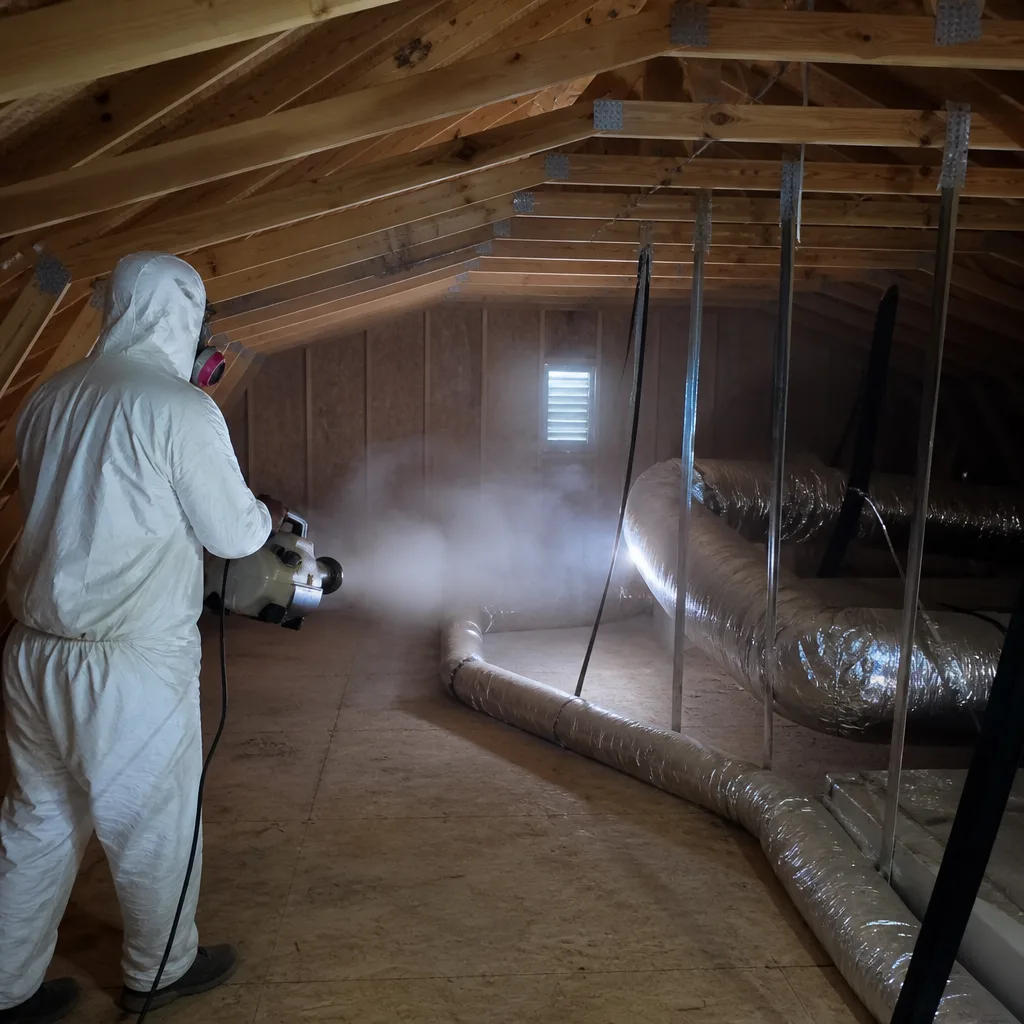
Last updated November 18, 2026
The Complete Blown-In Insulation Guide for Paradise Homeowners
The most common insulation mistake in Paradise isn’t choosing the wrong product. It’s installing the right product to the wrong depth. The R-38 that shows up on most contractor quotes for a Mojave attic floor is under-spec for our summers, and it’s why so many Paradise homeowners pay to insulate twice. Blown-in isn’t the “cheap option” people assume either. In Paradise’s housing stock, it’s often the smarter call. This guide covers the honest R-value target, cellulose versus fiberglass in desert heat, how to check your attic before you add a single bag, and how to verify a contractor hit spec without taking their word for it.
Quick Answer
For blown-in insulation on an attic floor in Paradise, NV, the honest target is R-49 to R-60 (roughly 16 to 20 inches of loose-fill fiberglass, or 13 to 16 inches of cellulose), not the R-38 many quotes default to. Because Paradise’s single-story homes with large vented attics lose so much heat through the ceiling, hitting that higher range usually pays back within a few years. Blown-in is often the better value here than spray foam when it’s installed to the correct depth and density.
Table of Contents
- Why R-49 to R-60 Is the Honest Target for a Paradise Attic
- Cellulose vs. Fiberglass Blown-In in a Desert Climate
- The Vented Attic Prerequisite: Check the Vents First
- Older Las Vegas Valley Homes and What a Retrofit Really Costs
- The Installation Density Problem: Bags Matter as Much as Depth
- How to Verify Your Contractor Hit Spec
- Common Mistakes to Avoid
- When to Call a Professional
Why R-49 to R-60 Is the Honest Target for a Paradise Attic
Most insulation quotes for a Paradise attic land at R-38. That number comes from older national guidance that was never tuned for the Mojave. Paradise sits in a high-desert climate where summer attic temperatures routinely climb past 150°F, and a single-story home with a big vented attic has most of its heat gain moving straight down through the ceiling. R-38 underperforms in that setup, especially on the west and south sides of the roof.
R-value is resistance to heat flow. More of it means less heat moving through the ceiling on a July afternoon. Here’s how the depths shake out for an attic floor in Paradise:
- R-38: about 12 to 13 inches of loose-fill fiberglass, or 10 to 11 inches of cellulose. Fine for milder climates, thin for ours.
- R-49: about 16 inches of fiberglass, or 13 inches of cellulose. The realistic minimum for most Paradise homes.
- R-60: about 20 inches of fiberglass, or 16 inches of cellulose. Worth considering for homes with high ceilings, older ductwork in the attic, or big west-facing roof planes.
Whether your current depth is actually delivering rated performance depends on three things: how much it has settled or been compressed, whether air sealing was done first, and whether the attic is properly vented. Blown fiberglass that’s been trampled around a duct run or a can light does not deliver the R-value printed on the bag. We regularly find Paradise attics rated at R-19 in the paperwork and closer to R-11 in reality once we measure the settled depth.
Cellulose vs. Fiberglass Blown-In in a Desert Climate
Both materials work in Paradise. The differences that matter here aren’t the same ones that matter in a humid climate.
- Fire resistance. Cellulose is treated with borate fire retardants, and fiberglass is inherently non-combustible. Both are fine for code. In the Las Vegas Valley, where wildfire risk is on the outskirts but not typically inside the residential grid, fire resistance is a secondary factor, not the deciding one.
- Pest resistance. Borate-treated cellulose resists termites and cockroaches better than fiberglass, which is part of why it’s common in older homes here. But in a desert, rodents are the bigger concern, and neither material deters them. Rodent proofing at the attic perimeter is the fix, not material choice.
- Settling. Cellulose settles more over time, roughly 15 to 20 percent, so it needs to be installed at a higher starting depth to hit the same R-value. Fiberglass settles less but loses R-value when compressed by foot traffic or ductwork.
- Dust and handling. In a dry climate, fiberglass tends to make more airborne dust during install. Cellulose dust settles faster. If your return-air ducts run through the attic, this affects the first week after installation.
For most Paradise homes, we recommend loose-fill fiberglass from a brand like Owens Corning or Johns Manville because it holds its rated R-value better in a hot, dry attic and is easier to inspect later. Cellulose is a solid choice when the priority is pest resistance or when the existing layer is already cellulose. The material matters less than the depth and the air sealing underneath it.
The Vented Attic Prerequisite: Check the Vents First
Blown-in performance in Paradise depends heavily on the attic breathing properly. A vented attic pulls cooler outside air in through the soffit vents and pushes hot air out through the ridge vents. That airflow keeps the attic closer to outdoor temperature instead of letting it bake. If those vents are blocked, adding insulation just traps more heat against the ceiling.
Before adding a single bag over an existing layer, here’s what needs to be checked:
- Soffit vents are clear. This is the most common failure. Blown insulation from a previous job, or even stored boxes, can smother the soffit vents. Baffles need to hold the insulation back so air can still move.
- Ridge vent is functioning. A blocked or painted-over ridge vent defeats the whole system. Check for visible daylight at the ridge from inside the attic.
- No exhaust fans dumping into the attic. A bathroom or kitchen fan exhausting into the attic pushes warm, moist air in and defeats the venting. It should exhaust outside.
- Attic access is sealed and insulated. An unsealed attic hatch can leak as much heat as a small window.
- No existing water intrusion. If there’s staining on the roof deck or rafters, fix the roof before insulating. Blown-in over a wet deck hides the problem and worsens it.
We check all five on every estimate in Paradise. If any one of them needs attention first, it’s cheaper to address it before the insulation goes in than after. A blocked soffit vent can quietly cancel out the energy savings you paid for.
Older Las Vegas Valley Homes and What a Retrofit Really Costs
Most of Paradise was built between the 1970s and the 1990s. During that stretch, the prevailing attic insulation standard for the Las Vegas Valley was far lower than it is today. R-11 to R-19 was common. Homes from that era often have 4 to 8 inches of loose fill on the attic floor, some of it settled and compressed. Modern energy code now expects much more, which is why so many Paradise homes are under-insulated by today’s standard even though nothing is “broken.”
A targeted blown-in retrofit means removing nothing and adding correctly. The typical range for a Paradise attic, depending on square footage, existing depth, and how much prep the attic needs, runs roughly as follows:
- Air sealing first: sealing top plates, can lights, and gaps around wiring and plumbing penetrations. This step is what actually stops the heat from moving. Skipping it and just blowing insulation is the most common waste of money.
- Adding R-38 to R-60 of blown-in: the bulk of the material cost, scaled to attic square footage.
- Ventilation prep: baffles at the soffits, and any repairs to blocked ridge vents.
- Attic hatch sealing and insulating: a small line item with a real payoff.
The savings come from the ceiling acting as a proper thermal boundary. In our experience across Paradise, homeowners in older single-story homes with large attics see the biggest proportional reduction in summer cooling cost, because that’s exactly the layout where the ceiling was losing the most heat. If your ducts run through the attic, the savings compound further. You can read more about how we approach ceilings on our Attic Insulation in Paradise page.
The Installation Density Problem: Bags Matter as Much as Depth
Two attics can show the same 16 inches on a tape measure and deliver completely different R-values. That’s the density problem, and it’s the single biggest gap between a good install and a bad one. Loose-fill insulation rated at R-49 requires a specific number of bags per thousand square feet to actually achieve R-49. Blow it in fluffy and it looks deep but insulates poorly. Blow it in too dense and it wastes money and can compress.
The manufacturer’s coverage chart is the reference. Every bag of Owens Corning, Johns Manville, Knauf, or any other loose-fill product is rated for a certain coverage at a given R-value. The math is simple:
- Measure the attic. Square footage of the attic floor, minus the areas you’re not insulating.
- Pick a target R-value. R-49 for most Paradise homes, R-60 for some.
- Read the bag chart. The chart tells you bags per thousand square feet at that R-value.
- Multiply. Attic square footage divided by 1,000, times bags per thousand, equals total bags.
- Verify on delivery. Count the bags that actually arrive. That’s your proof of density.
In our experience, this is where vague quotes fall apart. “Blown to 16 inches” without a bag count means nothing. A contractor who blows a few bags short of spec can hide it under a fluffier install and still hit the depth on a tape. The bag count on the invoice and the depth gauge in the attic together are what prove the job.
How to Verify Your Contractor Hit Spec
You don’t need to climb into a hot attic to check a contractor’s work. You need to ask for the right numbers, in the right format, before they start.
- Get the bag count in writing. The estimate or invoice should show the target R-value, the calculated bag count, and the depth. If the number is missing, ask.
- Ask for the manufacturer’s coverage chart for the product being installed. A reputable contractor will have it on hand. The math should line up.
- Do a depth check right after installation. A few minutes with a tape measure or a depth gauge in three or four spots (away from the edges, where installers add extra) tells you whether the target was hit.
- Look for even coverage. Low spots, bald patches, or insulation pushed into the soffit area are red flags.
- Confirm air sealing was actually done. The penetrations should be sealed before the insulation goes in. If you can see foam or caulk around the top plates, that’s a good sign.
Every estimate we write in Paradise shows the target R-value and the calculated bag count. That’s part of why we offer a free second opinion on any written estimate: if another quote is missing the bag count or the R-value target, we’ll tell you straight. If you’re evaluating Spray Foam Insulation in Paradise as an alternative, ask the same questions. Spray foam has its place, especially at the roofline, but its cost only makes sense when the attic setup calls for it.
Common Mistakes to Avoid
- Quoting R-38 as the target. Most Paradise quotes default to R-38 because that’s what the software was set to. For our climate, it’s under-spec. Ask for R-49 or R-60 and a justification if the contractor won’t go there.
- Blowing insulation without air sealing first. Blown-in alone sits on top of a leaky ceiling and lets the heat walk right past it. Air sealing the penetrations is the higher-return step, and it should happen first, every time.
- Ignoring blocked soffit vents. We see this in Paradise constantly: a previous install buried the soffit vents, and the attic stopped breathing. Baffles cost little and save a lot.
- Trusting “16 inches” without a bag count. Depth on a tape is easy to fake with fluffy product. Bags delivered and bags installed are the real measure.
- Skipping the attic hatch. An unsealed, uninsulated attic hatch leaks heat like a small open window and cancels out part of the ceiling insulation. Seal and insulate it on every job.
- Adding over a wet deck or active leak. If there’s staining on the roof deck or rafters, fix the source before insulating. Blown-in over moisture hides the problem and makes it worse.
- Choosing a contractor who won’t put the R-value and bag count in writing. A quote that only says “insulate attic” is not a quote. It’s a placeholder.
When to Call a Professional
Blown-in insulation looks simple from the outside: you rent a machine, you blow bags into the attic, you hit a depth, you’re done. In practice, the difficulty is in the details. Air sealing has to happen before the insulation, soffit baffles have to be in place, and the depth and density have to be verified against the bag count or the whole job underperforms. The attic itself is also a hot, confined space with can lights, wiring, and ductwork; it’s not a place to learn as you go. Call a professional when your attic has existing insulation you’re unsure how to assess, when you’re not sure what the target R-value should be, when you have moisture or pest issues to address first, or when the quote you got is vague and you want a second opinion. Skip any DIY step that involves crawling around a live electrical box in a 140°F attic. For Paradise homeowners, Walt’s Insulation Paradise offers free estimates in Paradise – call (844) 978-0556. If you’re also dealing with a damp crawl space or want to know how the ceiling ties into the rest of the envelope, our Crawl Space Encapsulation & Vapor Barrier in Paradise page covers that side of the house.
Frequently Asked Questions
For most Paradise attics, blown-in insulation with air sealing typically runs in the low-to-mid four figures depending on attic square footage, existing depth, and prep needed, with the bulk of the cost tied to material volume and air sealing. The higher R-value target for a Mojave attic floor means more material than a milder climate would use, but the payoff in summer cooling is also larger. Call (844) 978-0556 for an exact quote – estimates are free.
For most Paradise homes, no. R-38 is under-spec for a Mojave attic floor because attic temperatures routinely pass 150°F and single-story homes with large vented attics lose most of their heat through the ceiling. R-49 to R-60 is the honest target. A contractor who insists R-38 is fine should be able to explain why for your specific house, or be willing to give you a second opinion.
Both work in our dry climate, and the choice comes down to priorities. Loose-fill fiberglass from a brand like Owens Corning or Johns Manville holds its rated R-value better against settling and is easier to inspect years later, which is why we lean toward it for most Paradise attics. Borate-treated cellulose resists pests better. The material matters less than hitting the correct depth and density.
Yes. Air sealing the top plates, can lights, and wire and plumbing penetrations is the step that actually stops heat from moving. Blown-in over a leaky ceiling underperforms no matter how much you add. Every estimate we write for a Paradise home includes air sealing as a line item before the insulation goes in.
Ask for the target R-value, the calculated bag count, and the installed depth in writing, and count the bags that arrive on site. The manufacturer’s coverage chart gives bags per thousand square feet at a given R-value; the math should line up with the attic’s square footage. A contractor who won’t show the numbers is one to avoid.
Yes, in most cases. Blown-in is designed to go on top of an existing loose-fill layer. Before adding, the existing layer has to be checked for settled or compressed depth, moisture, and pest activity, and any soffit vents have to be protected with baffles. We assess all of that on every Paradise estimate before recommending how much to add.
The Bottom Line
Blown-in insulation in Paradise gets dismissed as the cheap option, but that’s only true when it’s installed wrong. Done right – air sealing first, soffit vents clear, R-49 to R-60 of loose fill, and a bag count that matches the depth – it’s often the smarter call than spray foam for the single-story Mojave homes that dominate Paradise. If your attic is under-insulated, the fix is straightforward and the savings show up on the next summer bill. Stay away from any quote that won’t put the R-value and the bag count in writing. If you want a straight answer on your attic, we’re the one down the road.
Walt’s Insulation Paradise works from a published address and license number – not an 800 number. A live person answers every call, day or night, so you reach someone who can actually help. We install products from trusted manufacturers including Owens Corning, Johns Manville, Knauf, and Rockwool. Every install is backed by the Done Right Promise: if it isn’t right, we make it right. Current offers include $40 off any repair over $200, a free second opinion on any written estimate, no trip charge inside our county, and a permanent 10% discount for seniors and veterans. If you want to know whether blown-in is the right call for your Paradise attic, call (844) 978-0556 for a free estimate. Estimates are upfront, no-hassle, and honest about what your house actually needs.
Written by the team at Walt’s Insulation Paradise.
Start with our Walt’s Insulation Paradise home page to see the full list of services, or call (844) 978-0556 and we’ll answer live.