
Last updated November 18, 2026
Attic Insulation Maintenance Checklist for Paradise Homeowners
The number-one reason attic insulation underperforms in Paradise homes isn’t age. It’s compression. A blown-in blanket that looks perfectly fine from the hatch can lose 40% of its R-value after an HVAC tech walks across it three summers in a row, and nobody’s the wiser until the August power bill jumps $80. Insulation doesn’t fail all at once here. It degrades in predictable, checkable ways, and most of it you can catch on a 20-minute walkthrough once or twice a year if you know exactly what to look for. This guide gives you that walkthrough, built around Paradise’s climate calendar, Clark County code, and the specific things we see going wrong in local attics.
Quick Answer
Attic insulation in Paradise should be inspected twice a year: once in late fall before heating season and once in late spring before the summer heat peaks. Check for compressed or settled insulation, moisture stains, pest activity, and gaps at the hatch and top plates. Blown-in insulation should hold the depth Clark County code requires for your R-value target, and any area flattened by foot traffic needs to be fluffed or topped off.
Table of Contents
- Why Paradise Attics Age Faster Than You Think
- The Paradise Insulation Calendar: What to Check Each Season
- How to Spot Compression Damage Without Pulling Up Insulation
- Signs Your Blown-In Insulation Has Settled Below Code Depth
- What to Do When You Find Moisture in a Desert Attic
- DIY vs. Professional: Which Tasks Are Safe to Do Yourself
- Your Printable Annual Checklist
- Common Mistakes to Avoid
Why Paradise Attics Age Faster Than You Think
Paradise sits in a stretch of the Mojave where attic temperatures routinely climb past 150°F between June and September. That heat does two things to insulation. It accelerates settling in loose-fill products like GreenFiber cellulose, and it bakes fiberglass batts until they sag away from the joists. Add the wide day-night temperature swing in spring and fall, and you’ve got an environment that quietly wears down material that would last decades in a milder climate.
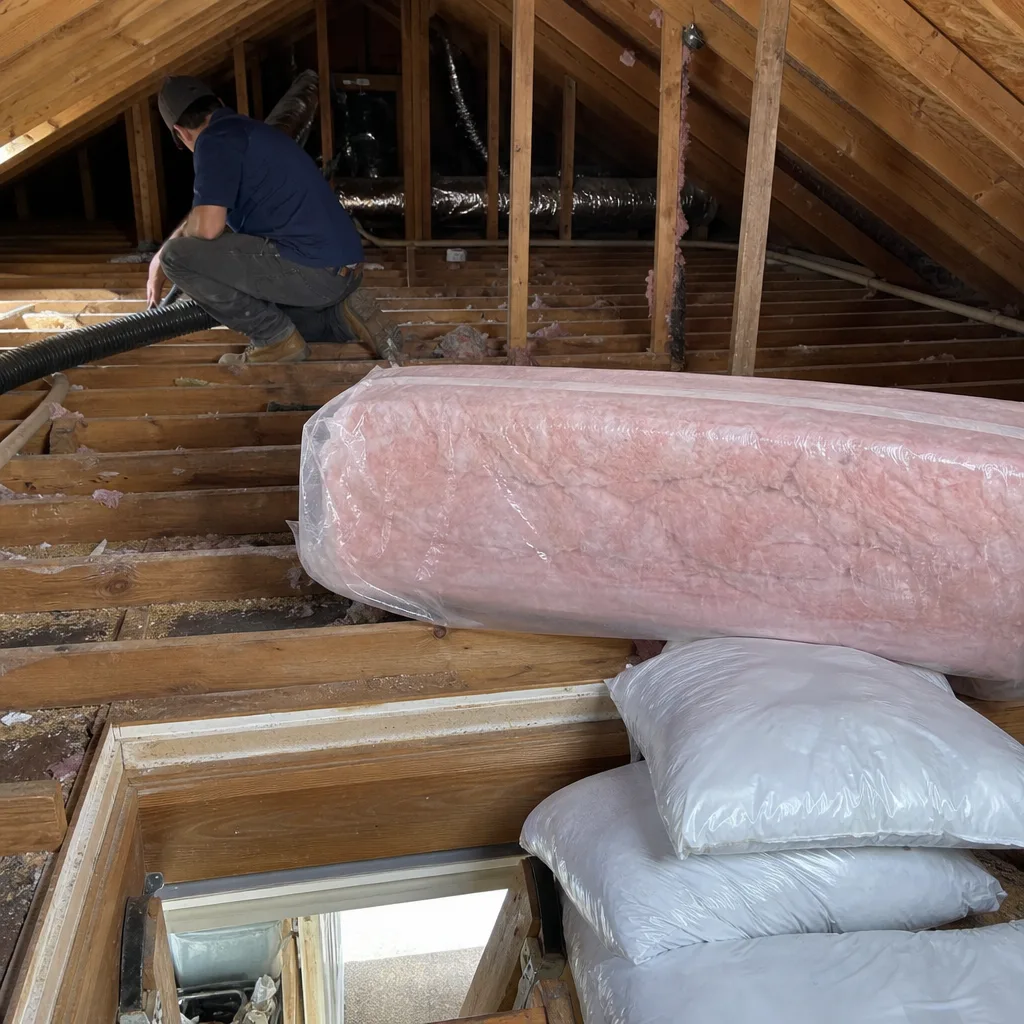
Then there’s the foot traffic. Every time a pest control tech, an HVAC contractor, or a solar installer climbs through the hatch, they compress whatever they step on. In our experience working attics across Paradise, we regularly find a beaten-down path running from the access hatch straight to the air handler. From the hatch looking in, everything looks level. From six inches away, that path is a canyon.
What makes the problem hard to notice is that insulation doesn’t announce itself. There’s no drip, no noise, no crack in the ceiling. You just pay more to cool the house, year after year, and assume that’s what power costs in Paradise now. For a look at how we bring an attic back up to spec, see our page on attic insulation in Paradise.
The Paradise Insulation Calendar: What to Check Each Season
Generic “inspect once a year” advice doesn’t fit Paradise. Our climate has two hard deadlines: the first cold snap in November and the first 105°F week in late May. Between them, insulation takes the beating. Here’s how we’d structure the year.
Late fall (November): Pre-heating-season check
- Walk the attic with a flashlight before the furnace starts running daily.
- Check for gaps where warm air can escape: around the hatch, recessed lights, and the tops of interior walls.
- Look for any sign of rodent activity, since mice move indoors when overnight lows drop.
- Confirm the vapor barrier under the blown-in layer isn’t torn or pulled back.
Late spring (May): Pre-summer check
- Measure blown-in depth in three or four spots and compare to what it was in the fall.
- Check the attic for any new compression paths from winter service visits.
- Look for moisture stains, especially on the north-facing roof deck.
- Inspect the hatch seal, since a leaky hatch acts like an open window once the AC starts running hard.
The rest of the year
After any service visit to the attic (HVAC, pest control, electrical), walk it once more within a week. That one habit catches most of the damage before it compounds. If you have a swamp cooler, add a mid-summer check for moisture around the duct penetration; that’s a spot we see fail more in Paradise than anywhere else.
How to Spot Compression Damage Without Pulling Up Insulation
You don’t need to disturb the insulation to find compression. You just need to know the visual cues. From the hatch or a safe boardwalk, here’s what to look for, in order:
- Look for paths. Any flattened trail from the hatch to the air handler, furnace, or duct runs is a compression zone.
- Compare heights. If the insulation near the hatch is visibly puffier than it is three feet in, someone walked there. Loose-fill should look uniformly fluffy across the whole field.
- Check darker patches. Compressed insulation holds dust differently and will often read darker or greyer than the fluff around it.
- Inspect around duct supports. Insulation that’s been pushed aside around hangers or strapping leaves gaps you can see from above.
- Look at the top plates. The tops of exterior walls should be fully buried. If you can see wood, the insulation has pulled back or been knocked aside.
If you find a compressed zone, resist the urge to rake it flat yourself. Loose-fill that’s been mashed down doesn’t recover its loft just by being disturbed; it needs to be topped off with fresh material to restore the R-value. That’s the part where a pro with a blowing machine makes the difference. We work with Owens Corning and GreenFiber loose-fill, both of which settle predictably when installed to the right depth in a Paradise attic.
Signs Your Blown-In Insulation Has Settled Below Code Depth
Blown-in insulation settles. That’s normal, and good installers account for it by blowing to a slightly higher initial depth. But when it settles below the minimum for your target R-value, the house starts losing heat in exactly the ways you’d expect. In Clark County’s climate zone, most Paradise homes should be targeting R-38 to R-49 in the attic, which means loose-fill fiberglass or cellulose needs to sit at roughly 13 to 16 inches depending on the product.
Here’s how to tell yours has settled too far:
- The visible depth at multiple points is noticeably lower than it was a year or two ago.
- You can see the tops of the ceiling joists. That’s a clear sign of insufficient depth; joists should be buried.
- Winter heating bills have crept up without a rate change.
- Rooms on the south and west sides of the house feel hotter than the rest in July.
- A previous installer never gave you an installed-depth measurement; if you don’t know your starting depth, you can’t tell whether it’s settled.
Measure at four points spread across the attic, keeping a tape measure vertical and not pressing down. If you’re below the marked depth, it’s time to add material. Our team can recheck the numbers against the R-value targets we use for Paradise homes and give you a straight answer on whether you actually need more insulation or just better air sealing.
What to Do When You Find Moisture in a Desert Attic
It’s counterintuitive in a place as dry as Paradise, but moisture in desert attics is real, and the cause is almost always the same handful of things. When warm, moist air from the living space leaks up through gaps and hits a cool roof deck on a winter night, it condenses. So the moisture you see is not rain getting in; it’s your indoor air telling you the attic isn’t sealed from the house.
Common culprits we find in Paradise:
- Unsealed can lights and ceiling fans letting conditioned air into the attic.
- Missing or torn gaskets around the attic hatch.
- Bathroom exhaust fans venting into the attic instead of outdoors.
- Cracked or disconnected HVAC flex duct sweating in the summer heat.
- Swamp cooler penetrations that weren’t sealed properly at install.
If you find staining on the roof deck, dark spots on the insulation, or a musty smell, don’t cover it up with more insulation. Find the source first. Small amounts of surface condensation on the north deck in January are usually a venting or air-sealing issue, and the fix is sealing the leaks, not replacing the insulation. Larger stains or any soft, sagging deck material should get a professional look right away, because the structural side of moisture is not a DIY problem.
While you’re up there addressing moisture, it’s worth checking the crawl space encapsulation and vapor barrier in Paradise at the same time. Moisture in the crawl space pushes up into the house and often ends up in the attic as indoor humidity.
DIY vs. Professional: Which Tasks Are Safe to Do Yourself
Most attic maintenance is safe for a careful homeowner, and some of it isn’t. The distinction is simple: anything that involves touching materials with your hands and eyes while standing on solid ground is fair game. Anything involving the electrical system, the HVAC system, structural moisture, or the roof deck is not.
Safe for a homeowner
- Visual inspection of insulation depth, compression, and stains.
- Replacing a torn hatch gasket with a new weatherstrip.
- Measuring loose-fill depth with a tape measure.
- Looking for gaps around the hatch, can lights, and top plates.
- Checking whether bath fans are vented outdoors by looking for the exterior hood.
Worth a professional
- Any work around recessed light fixtures or wiring; the safety risk isn’t worth it.
- Re-sealing around HVAC duct penetrations.
- Diagnosing roof-deck moisture or structural staining.
- Top-off blowing, since getting the depth and density right is what determines the R-value.
- Rodent proofing, since the entry points need to be sealed correctly and safely.
There’s one thing worth flagging for anyone thinking about tackling this themselves: loose-fill fiberglass and cellulose are respiratory irritants, and attics in Paradise routinely hit 140°F by mid-morning in summer. If you go up, go early, wear a mask and long sleeves, and use a properly supported walking surface. Don’t step between joists. Every year we hear about someone putting a foot through a ceiling in a Paradise home because they trusted the drywall to hold them.
Your Printable Annual Checklist
Here’s the condensed version, ready to print and stick on the inside of the attic hatch.
- Fall (November): flashlight walk, check hatch seal, check top plates, confirm vapor barrier, check for rodent signs.
- After any attic service visit: walk the path the tech followed, check for new compression.
- Spring (May): measure loose-fill depth at four points, check for moisture stains, check north deck and duct penetrations.
- Mid-summer (if you have a swamp cooler): check for moisture around the duct penetration, confirm it’s sealed.
- Annually: compare winter and summer power bills year over year; a creeping increase with no rate change is your insulation waving a hand.
- Every 3-5 years: have a professional re-check installed depth against current Clark County code for your R-value target.
That’s it. Twenty minutes each time. If you want the deeper framework on air sealing and spray foam options for the areas where loose-fill just can’t do the job, our page on spray foam insulation in Paradise explains where it fits. And if you’re starting fresh, the Walt’s Insulation Paradise home page is a good place to see everything we handle.
Common Mistakes to Avoid
- Going off the sticker price on the box. Big-box batts label an R-value based on their uninstalled thickness, and once they’re compressed or installed poorly, that number is fiction. You’re paying for an installed R-value, not a package claim.
- Adding insulation over the problem. If there’s a leak or a moisture source, covering it with more material traps water against the deck. Fix the source first, then insulate.
- Ignoring air sealing. Blowing more insulation into an unsealed attic is like putting on a thicker coat with the zipper open. Insulation only performs when the attic is sealed from the house.
- Stepping off the joists. We get calls every summer from Paradise homeowners who put a foot through a ceiling. Always use a boardwalk or a proper walking plank.
- Judging by feel. A flashlight beam grazing low insulation looks flat and full. You need a tape measure and a target depth, not a visual check from the hatch.
- Letting an HVAC tech walk the attic unsupervised. Ask the technician ahead of time to stay on the walkway. It saves a top-off later.
- Skipping the north-facing deck check in winter. That’s where condensation stains show up first in Paradise, and it’s the easiest place to catch a moisture problem before it spreads.
When to Call a Professional
Call us when you find moisture stains on the roof deck, when you can see the tops of the ceiling joists from the hatch, when the depth measurement is below your code target, or when a service visit leaves a flattened trail across the attic. Call us if you’ve never had the attic properly assessed, or if you suspect pest activity, since rodent proofing needs to be tied to proper sealing. And call us if you’re planning to add material yourself but want to know exactly what depth and product to use. Walt’s Insulation Paradise offers free estimates in Paradise, gives a free second opinion on any written estimate, and there’s no trip charge inside the service county. Reach us at (844) 978-0556.
Frequently Asked Questions
Twice a year is ideal for Paradise homes: once in late fall before heating season and once in late spring before summer heat arrives. After any attic service visit (HVAC, pest control, solar), do a quick walk the same week to catch compressed paths before they compound.
Measure the loose-fill depth at four points and compare it to the depth your installer used or the depth that matches your Clark County R-value target. If the depth is below target, or if you can see the tops of the ceiling joists, it’s settled too far and needs a top-off. Call (844) 978-0556 for an exact quote and a no-pressure depth check.
Yes, and it’s almost always from indoor air escaping into the attic and condensing on a cool roof deck, not from rain. The fix is air sealing the leaks around lights, hatch, duct penetrations, and fans, not adding insulation. If you find significant staining, get a pro out to check for structural issues before doing anything else.
You can add insulation over the existing material, and that’s often what a top-off involves, but only after the attic has been checked for moisture, air leaks, and compression. Adding material over a leak or an unsealed hatch just hides the problem. Call (844) 978-0556 – estimates are free and include a free second opinion on any written estimate you’ve already received.
Most Paradise homes should target R-38 to R-49 in the attic, which works out to roughly 13 to 16 inches of loose-fill depending on the product. Local code minimums and your home’s age, ductwork, and air sealing design all affect the number, so it’s worth having someone measure rather than guess. Call (844) 978-0556 for a free estimate on the exact target for your home.
Cost depends on the attic square footage, how much depth you’re adding, and whether air sealing is included. We give upfront pricing before the work starts, offer $40 off any repair over $200, waive the trip charge inside the service county, and give a permanent 10% discount to seniors and veterans. Call (844) 978-0556 for an exact number.
The Bottom Line
The good news is that attic insulation in Paradise is one of the cheapest home systems to maintain, and most of the failures are catchable by eye if you check on the right schedule. Keep to the fall-and-spring walkthrough, measure depth instead of eyeballing it, and watch for compression paths after service visits. Fix moisture at the source before covering it up. Handle the safe items yourself, leave electrical, HVAC, and structural moisture alone. If the numbers say you need a top-off, or if the attic has never been checked, we can take a look. Our technicians have up to 26 years of experience with the products that work in Southern Nevada attics. Every install is backed by the Done Right Promise: if it’s not done right, we make it right.
Ready to schedule a free attic inspection in Paradise? Call (844) 978-0556 today. A live person answers every call, 24/7. We’ll measure your depth, check for moisture and compression, and give you an upfront price before any work starts.
Written by the team at Walt’s Insulation Paradise.