
Last updated November 18, 2026
DIY vs Professional Blown-In Insulation: What’s Safe to Do Yourself
The insulation bags stacked at the hardware store promise a 40-bag weekend project, and the rental blower is sitting right there by the checkout. But a Paradise attic that climbs past 160°F in July won’t grade your work on effort. If you blow cellulose to 8 inches instead of the 14 to 16 inches that actually matters here, that thin top layer does almost nothing, and you’ll watch the savings evaporate through the next three power bills. This guide is for the homeowner who’s genuinely thinking about doing it themselves, not the one looking for someone to talk them out of it. We’ll name the two or three places where a weekend job turns into a remediation nightmare, tell you what you can actually handle, and help you decide with your eyes open.
Quick Answer
You can safely top off existing blown-in cellulose in an open, dry, unobstructed Paradise attic yourself, using a rental blower and a partner. You should not touch dense-pack wall cavities, vapor barriers, or any attic with knob-and-tube wiring, inadequate ventilation, or signs of moisture. Those require a licensed pro who knows Paradise’s climate requirements, and getting them wrong costs far more than the labor you saved.
Table of Contents
- What DIY Blown-In Insulation You Can Realistically Handle
- The Tasks That Require a Licensed Pro (And Why)
- Does the Rental Blower Actually Pencil Out?
- Why Paradise’s Climate Changes the Math
- The Insurance Angle Nobody Mentions
- How Blown-In Insulation Actually Works
- What to Ask a Contractor Before Hiring in Paradise
- What Materials Should You Use?
What DIY Blown-In Insulation You Can Realistically Handle
There’s a real, honest answer here, and it isn’t “nothing.” Some blown-in work is well within reach for a careful homeowner with a partner and a Saturday. We’ve seen plenty of Paradise homeowners do a clean, safe top-off job on an accessible attic and get a genuine improvement in comfort. The key is knowing exactly what falls inside that line.
A DIY top-off makes sense when all of the following are true:
- You’re adding to existing loose-fill, not starting from scratch. Topping off permits fibers to settle into a consistent bed as you go. Bare joists with nothing on them are a different job.
- The attic is open and walkable, with no ductwork maze, no recessed can lights buried in the field, and no blown-in baffles you’d knock loose.
- No moisture history. No water stains, no soft sheathing, no mold smell, no ice-dam evidence on the north slope.
- You’ve already air sealed. Chasing insulation around unsealed recessed lights and top plates wastes most of the value.
- Your electrical is modern. No knob-and-tube visible, and no junction boxes buried under the material you’re about to bury deeper.
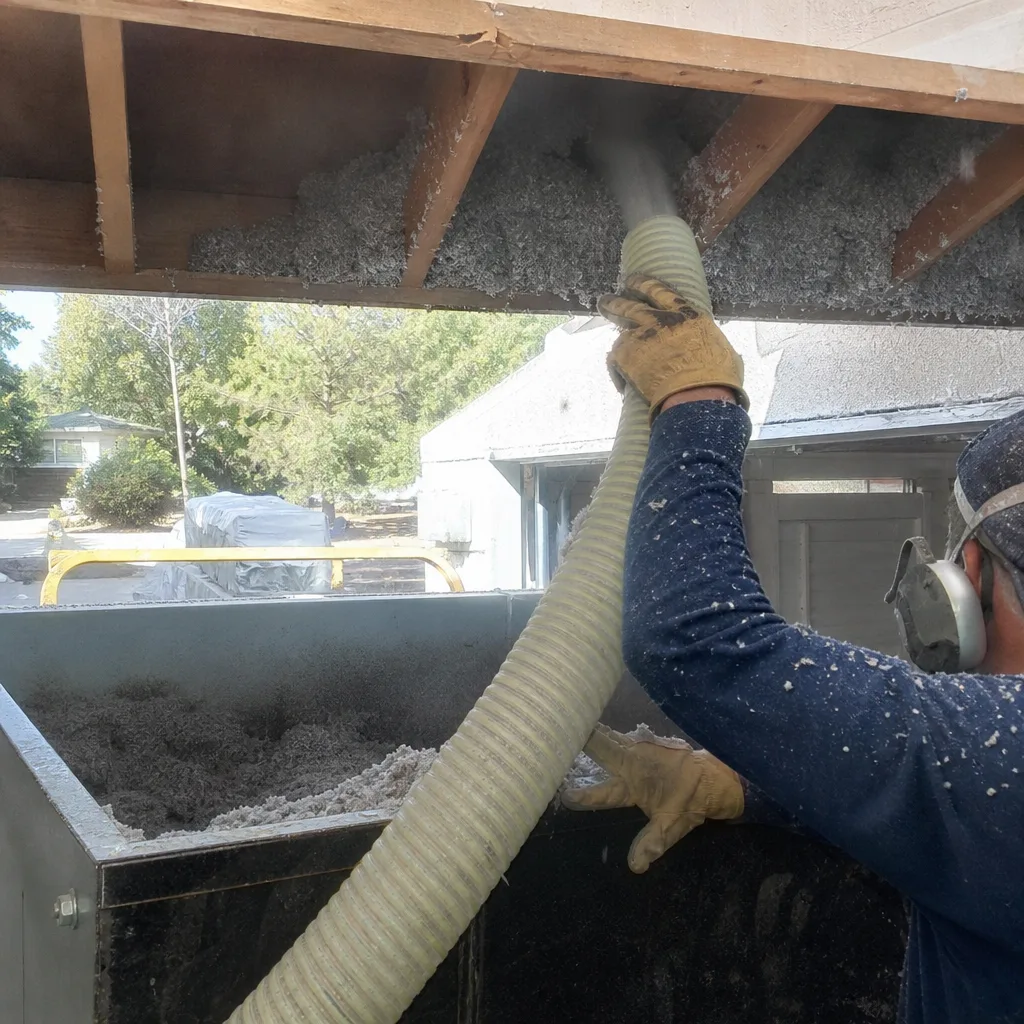
The task itself is straightforward: mark the target depth with a ruler stapled to joists, have one person feed the hopper while another sweeps the hose, keep the machine on a dedicated circuit, and don’t fill the bays around the eaves where you’d block soffit ventilation. If you hit a wall of ductwork, you stop. If you find a problem, you stop. For most confident homeowners in Paradise, that’s the honest boundary.
The Tasks That Require a Licensed Pro (And Why)
Blown-in insulation looks like a low-risk job because it’s fluffy and not obviously dangerous. The trouble sits in a few specific spots where the wrong material, the wrong density, or the wrong installation sequence creates a problem you may not notice for two summers.
These tasks should be handled by a licensed, insured professional with real Paradise experience:
- Vapor barriers and crawl space encapsulation. Retrofitting a proper vapor barrier under a house means knowing how the ground moves, how the vents are configured, and how the barrier ties to the sill. Do it wrong and you trap moisture under the floor. This is the work outlined in our Crawl Space Encapsulation & Vapor Barrier in Paradise page, and it is not a rental-blower job.
- Dense-pack wall cavities. To blow insulation into existing wall cavities you need a two-hole or three-hole pattern, a specific density target (typically 3 to 3.5 lb/ft³ for cellulose), and calibrated pressure. Underpack and it settles and sags. Overpack and you can bow drywall or crack plaster.
- Any attic with knob-and-tube wiring. You cannot bury knob-and-tube. Period. It needs to be seen and corrected or listed in a report before any insulation covers it. An inspector or electrician has to be involved.
- Attics with inadequate ventilation. If you don’t have enough intake and exhaust airflow, adding insulation can raise the risk of moisture buildup in the sheathing. This needs to be calculated and corrected first, and that calculation is more than a tape measure.
- Any attic showing active moisture. Stained sheathing, softened roof decking, or a smell you can’t place means you find the source before you add product on top of it.
None of these are “hard” in a way that means you’d fail if you tried. They’re hard in the sense that a mistake hides for a long time and only surfaces when it’s expensive.
Does the Rental Blower Actually Pencil Out?
This is where the arithmetic gets uncomfortable. The hardware store sticker says “$55 for the blower, 40 bags, easy weekend.” The real number depends on whether you do the job correctly the first time.
| Line item | DIY estimate | Professional estimate |
|---|---|---|
| Rental blower (24-hour, 2 days typical) | $80 – $140 | Included |
| Blown-in cellulose coverage for a 1,000 sq ft Paradise attic to R-49 | $600 – $1,000 in material (GreenFiber or similar) | $1,800 – $3,200 installed |
| Air sealing kit and foam | $60 – $150 | Included |
| Respirator, goggles, coveralls, knee pads | $80 – $130 | Not on you |
| Depth rulers, staple gun, hose partner labor | $0 – $150 | Included |
| Redo-the-job risk if depth comes up short | Full material cost, second rental | Covered by our Done Right Promise |
Run the numbers honestly and the DIY savings land somewhere between $500 and $1,200 on a typical single-story Paradise attic. That’s real money. But the moment you buy the whole job twice because the depth was wrong, the material was the wrong product, or a ventilation problem showed up after you covered it, you’re at or past the professional price with none of the warranty. A single mistake erases the savings. Two mistakes put you behind.
Call (844) 978-0556 for a free second opinion on any written estimate before you commit to either path. We’ll tell you plainly if your attic is a safe DIY project.
Why Paradise’s Climate Changes the Math
Blown-in insulation guidance from a national manufacturer assumes an average climate. Paradise does not run an average climate. We’ve been doing this work here for a long time, and the local numbers matter in ways that don’t show up in the bag-of-cellulose calculator.
A few things specific to Paradise attics:
- Peak attic temperatures push well past 160°F in July and August. That means any gap in coverage, any thin bay along the eaves, becomes an outsized heat path. Standard depth targets that would be fine in a cooler market leave real money on the table here.
- Winter nights drop into the teens on cold snaps. Ceiling joists in older Paradise homes were never designed for the temperature swing our valleys give them, so proper R-value targets plus air sealing matter more than material choice alone.
- Summer monsoon moisture rolls through. The seasonal swing between super-dry summer and humid monsoon weeks punishes any attic with marginal ventilation. Adding insulation on top of a marginal ventilation setup makes the condensation window tighter, not looser.
- Local building department requirements. Paradise permitting for insulation retrofits generally follows Nevada energy code amendments, and any wall or cavity work touches permits. A licensed pro knows what triggers a permit in Paradise and what doesn’t. A homeowner guessing at it is the person the inspector sends back.
That’s the difference between a generic recommendation and a real one: the R-value target that’s actually right for a Paradise attic in 2026 is not the same number a national blog will hand you.
The Insurance Angle Nobody Mentions
Here’s a quiet problem with DIY insulation that surfaces months or years later: what it does to a homeowner’s insurance claim when moisture damage shows up. We’ve had homeowners call us after a claims adjuster walked an attic and refused a portion of the loss because the insulation had been installed improperly or had covered a defect the homeowner should have caught.
The short version:
- Most homeowner policies exclude damage that results from improper installation, including mold and rot stemming from a vapor barrier wrongly installed or insulation laid directly on wet sheathing.
- If your insurer determines the loss stems from unpermitted work, they can deny the affected portion of a claim, and retroactive underwriting can flag the home at renewal.
- Professional work comes with a workmanship warranty, and the contractor carries liability coverage. If a professional installation fails, that warranty and that insurance are the backstop. DIY has neither.
This doesn’t mean DIY is automatically a claim problem. It means the cost calculation has to include the risk that a hidden mistake turns what you saved in labor into a five-figure repair that your policy won’t touch.
How Blown-In Insulation Actually Works
Understanding the mechanics makes the DIY-vs-pro decision clearer, because you can see where the failure points sit.
- Air sealing comes first. Every gap in the ceiling plane, every recessed light can, every top plate penetration, every wire chase is a hole air moves through. Sealing before insulation is what actually stops heat loss. Insulation slows the remaining conduction.
- The blower fluffs and flings the material. Cellulose or fiberglass is broken up by a rotating toothed wheel and blown through a hose. The material expands as it flies. That expansion is why the “40 bags” on the packaging covers less area than the numbers suggest.
- Density controls performance. Loose-fill in an attic runs at 1.5 to 2 lb/ft³ and depends on consistent depth. Dense-pack in a wall runs at 3 to 3.5 lb/ft³ and depends on calibrated pressure. Two completely different skills.
- Settling reduces depth over the first few years. Cellulose settles roughly 15 to 20% in the first two to three years. Any installation has to account for it. A DIY job targeting the “right” depth without settling margin shows up short in a couple of years.
- Ventilation has to breathe around it. Baffles, soffit vents, ridge vents, and any attic fan have to stay clear. Blowing material over a baffle is a common DIY miss.
If you want the full picture of what proper attic insulation involves, our Attic Insulation in Paradise page walks through the whole sequence.
What to Ask a Contractor Before Hiring in Paradise
Most “questions to ask a contractor” lists are generic. These aren’t. These are the questions that specifically test whether the person quoting your job actually knows Paradise’s attic environment and code requirements.
- “What R-value are you targeting for a Paradise attic, and why?” A real local pro will give you a number and explain what it accounts for: the summer attic temps, the winter swing, the ceiling joist construction in your home. A vague answer means they’re applying a national rule of thumb.
- “What’s the ventilation calculation on my attic?” They should measure attic floor area, check current intake and exhaust square footage, and tell you whether adding insulation requires correcting ventilation first. No calculation, no confidence.
- “How do you handle settling margin for cellulose?” If they say “we install to the target depth,” ask what happens at year three. A pro installs to account for settling or specifies a fiberglass product that settles less.
- “What’s your permit responsibility in Paradise?” The local professional should be able to tell you which scopes require permits and be the one pulling them.
- “How do you handle existing knob-and-tube or buried junctions?” The answer should be: they stop and get it corrected before covering anything. Never “we just blow around it.”
- “What’s your warranty, exactly?” Ask what’s covered, for how long, and who does the work if it fails. The local pro we connect you with carries the Done Right Promise: if it’s not done right, the work is made right, no runaround.
- “Can I get a written estimate and a free second opinion on it?” A second opinion on any written estimate is a standing offer. If a contractor balks at that request, that’s information.
We’ve watched this list separate the local pros who genuinely know Paradise from the crews that treat every attic like it’s in a suburb of Dallas.
What Materials Should You Use?
If you do go the DIY route on a safe top-off job, material choice matters more than the blower. Blown-in cellulose is the standard for retrofits, and it’s what makes the most sense for most Paradise attics over fiberglass loose-fill. It’s denser, it settles less predictably than advertised, and it handles our temperature swings better than loose fiberglass. For a homeowner buying their own material, GreenFiber and Owens Corning both make consumer-available blown-in cellulose that performs well.
For professional work, the products that get specified for Paradise homes typically include GreenFiber cellulose, Owens Corning and Johns Manville fiberglass, and Knauf for certain cavity applications. Our professionals are experienced with these materials, and they specify based on the specific attic, not a one-size recommendation.
If the attic has spray foam implications, which is common when air sealing and insulation are being considered together, that’s a different math entirely. See our Spray Foam Insulation in Paradise page for how that decision gets made.
Common Mistakes to Avoid
- Targeting the wrong depth for a Paradise attic. National calculators hand out a depth that assumes an average climate. In a Paradise July, under-depth costs you most of what you’d have saved in labor. Target the local R-value, not the generic one.
- Blowing over unsealed air leaks. Cellulose slows conduction; it does nothing to stop air movement through top plates, can lights, and wire chases. If you skip air sealing, you’ve bought material to slow down a problem you didn’t fix.
- Burying baffles and soffit vents. A surprisingly common DIY miss: sweeping material right into the eaves and choking off the intake vent that keeps the roof deck dry. Every baffle stays visible and clear.
- Adding insulation without addressing ventilation. In a Paradise attic that swings from dry summer to humid monsoon weeks, marginal ventilation gets tighter, not looser, when you add insulation. Ventilation gets corrected first.
- Doing this on a home with knob-and-tube wiring. Burying knob-and-tube is a code violation and a fire risk. This is a stop-work signal, not a “work around it” situation.
- Ignoring settling. Cellulose settles 15 to 20% over a few years. If you install to the exact target depth as the packaging says, you’re at year-three depth on day one, which is often short of where you need to be.
- Not documenting the work for insurance. If you do it yourself, photograph everything before and after, keep material receipts, and note the depth measurements. If moisture damage shows up later, documentation is the difference between a covered claim and a denied one.
When to Call a Professional
Call a professional if any of these are true: knob-and-tube wiring anywhere in the attic, any sign of past or current moisture in the sheathing, dense-pack wall cavities, adding vapor barriers or crawl space encapsulation, ventilation that isn’t clearly pulling its weight, an attic you can’t safely stand in, or a home with recessed lighting and ductwork that would take a full weekend just to work around safely. Also call if the total insulation area exceeds what you can confidently cover in one rental window, because a half-finished job is worse than either full path.
Walt’s Insulation Paradise offers free estimates in Paradise, and a free second opinion on any written estimate you’ve already got, including a verbal quote from a chain. No trip charge inside our service county, and a standing 10% discount for seniors and veterans. Call (844) 978-0556 and a live person answers, day or night – no voicemail, no answering service.
Frequently Asked Questions
Yes, in a narrow set of conditions: an open, walkable, dry attic with no knob-and-tube wiring, no ventilation problems, and existing loose-fill you’re topping off. You need to air seal first, mark the target depth for a Paradise climate, keep baffles clear, and plan the job for two people and a full day. If any of those conditions fails, the answer is no, and the job belongs to a licensed pro.
Usually repair and top off, not full replace. Blown-in cellulose that’s clean, dry, and free of rodent contamination is almost always topped off rather than removed. Removal and replacement in Paradise typically runs higher per square foot and gets triggered by moisture damage, pest contamination (rodents, typically), or compressed material that can’t be brought back to target R-value. Call (844) 978-0556 for a free estimate; we’ll tell you honestly whether the existing material is worth keeping.
For a professionally installed attic, expect roughly $2 to $4 per square foot depending on the R-value target and whether air sealing is being done. A typical 1,000-square-foot Paradise attic lands in the $1,800 to $3,200 range for R-49. DIY material cost runs $600 to $1,000 for the same area, plus the blower rental and safety gear. Call (844) 978-0556 for an exact quote; estimates are free and there’s no trip charge inside the service county.
It can, specifically for moisture-related claims. Insurers frequently exclude damage from improper installation, and unpermitted work can trigger a partial denial at claim time. If you do it yourself, photograph the work thoroughly, keep every receipt, and document the depths you hit. If you’d rather have the workmanship warranty and contractor liability sitting behind the job, that’s what professional work provides.
Check three things before you buy a single bag: (1) the wiring – no knob-and-tube, no buried junction boxes; (2) the sheathing and ceiling joists – no soft spots, stains, or smell; (3) the ventilation – confirmed intake and exhaust are both open and not obstructed. If any check fails, stop and get a professional assessment. This matters more in Paradise than in a cooler market because our attic temperatures are punishing and moisture mistakes show up fast.
For most Paradise homes, R-49 to R-60 in the attic is the range that makes sense given summer attic temperatures that push past 160°F and winter nights that dip into the teens. The exact number depends on ceiling joist construction, HVAC duct placement, and existing insulation condition. Any pro working in Paradise should be able to tell you your target number and why. Call (844) 978-0556 and we’ll walk you through it for your specific home.
The Bottom Line
The rental blower is real, and some homeowners in Paradise can use it safely. A clean, dry, open attic without knob-and-tube or ventilation problems is a genuine DIY candidate, and a careful homeowner can save $500 to $1,200 on a typical job. Everything else – walls, vapor barriers, marginal ventilation, wiring, moisture history – belongs to a licensed pro. The insurance math alone usually tips the decision when there’s any doubt. If you’re a local homeowner who wants a straight answer instead of a hard sell, Walt’s Insulation Paradise will tell you which side of that line your attic sits on. Welcome back to the Walt’s Insulation Paradise home page if you want to see the rest of what we do. Call (844) 978-0556 for a free estimate – a live person answers, 24/7.
Written by the team at Walt’s Insulation Paradise.