
Last updated November 18, 2026
The Complete Spray Foam Insulation Guide for Paradise Homeowners
When your attic hits 160°F on a July afternoon, the R-value rating on the bag means almost nothing if the foam wasn’t applied to the right surface. That’s the part most national guides skip. Spray foam in Paradise, NV isn’t a winter-cold problem or a summer-humidity problem – it’s a radiant-heat problem, and the material, thickness, and surface preparation all have to answer to that. In this guide you’ll learn how open-cell and closed-cell foam actually behave in Mojave dry heat, why tile roofs on Paradise homes create an application challenge most installers never mention, what an unvented attic can do that fiberglass batts can’t, the Clark County code items a licensed crew handles that DIY kits skip, and real cost-per-square-foot ranges based on local job types rather than national averages that underquote this market by 20-30%.
Quick Answer
Spray foam insulation in Paradise, NV typically runs $1.50-$4.50 per square foot installed depending on whether you choose open-cell or closed-cell and how thick the application is, and most single-family attics are completed in one to two days. For the Mojave climate, closed-cell foam under the roof deck is usually the strongest choice because it blocks radiant heat, seals the attic as an unvented assembly, and holds up to 160°F-plus deck temperatures. Open-cell foam works in interior walls and some crawl space applications, but it’s a weaker fit directly under a sun-baked roof deck in Paradise.
Table of Contents
- Why Spray Foam Works Differently in Paradise Than in National Guides
- Open-Cell vs. Closed-Cell in Extreme Dry Heat
- The Tile Roof Challenge on Paradise Homes
- Unvented Attics and the Hot Roof Design
- Clark County Code and Permit Requirements
- What Spray Foam Insulation Costs in Paradise
- How a Professional Spray Foam Job Works, Step by Step
- Common Mistakes to Avoid
- When to Call a Professional
- Frequently Asked Questions
- The Bottom Line
Why Spray Foam Works Differently in Paradise Than in National Guides
Most spray foam content online is written for a climate with cold winters and humid summers. The arguments center on vapor drive, condensation control, and keeping winter heat in. Paradise has neither of those problems. Our summer afternoons routinely push past 110°F, the attic cavity above a tile roof can sit well above 150°F for hours, and our annual rainfall is measured in a few inches rather than a few feet. The dominant load on a Paradise home is radiant heat pouring down through the roof deck, not moist air pushing through a wall.
That single fact reshapes how you should think about foam. A traditional climate guide will tell you to obsess over vapor permeance. In Paradise the priorities are different: reflectance of heat at the deck, airtightness of the assembly, and stability of the foam at sustained high temperature. Those are the criteria that separate a good spray foam job from a bad one here.
What a spray foam installation actually does for a Paradise home:
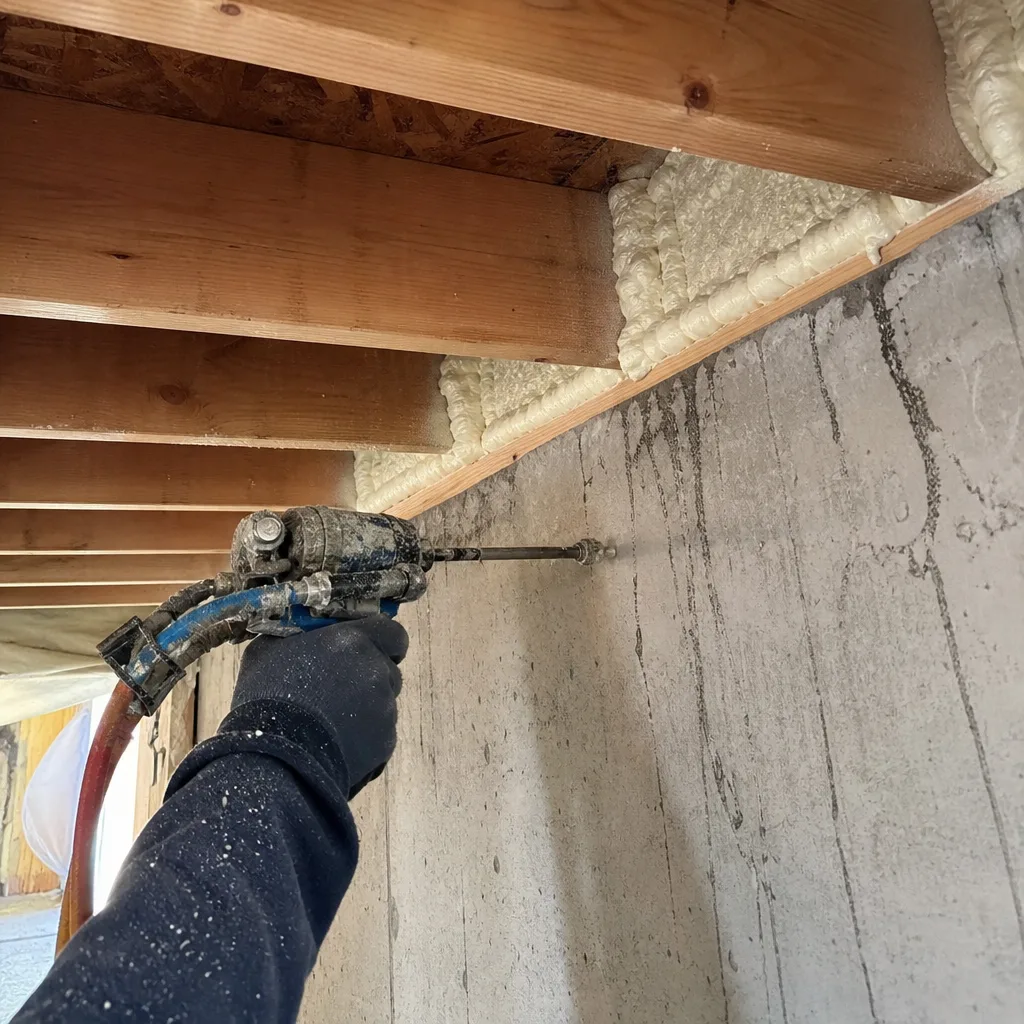
- Seals the roof deck as a continuous barrier so 160°F attic air doesn’t circulate down into living space
- Eliminates the air leakage points that dominate a Paradise home’s cooling load – recessed lights, top plates, plumbing penetrations, and duct boots
- Removes the need for passive roof vents to fight the heat, because the conditioned boundary moves to the underside of the deck
- Holds its shape and adhesion over thousands of thermal cycles, from a cool winter morning in the 40s to a July deck surface past 150°F
If you’ve already been quoted batts and want to understand the difference, our attic insulation in Paradise page walks through how each material performs in Mojave heat. But the shortest version: in a Paradise attic, air sealing is not a bonus – it’s the whole job. Spray foam does the sealing and insulating in one pass.
Open-Cell vs. Closed-Cell in Extreme Dry Heat
Every national guide says closed-cell is for humid climates, open-cell is for dry ones, and then they argue about vapor. That argument only half-holds in Paradise. Where we see the decisive difference between the two foams is not moisture – it’s temperature tolerance and radiant heat performance under the deck.
Closed-cell in Paradise
Closed-cell foam, at around 2 lb per cubic foot, cures to a rigid, dense plastic with an R-value of roughly R-6 to R-7 per inch. It’s the material most often specified under a Mojave roof deck because it holds structural rigidity at sustained high deck temperatures and adds a small amount of racking resistance to the assembly. It also, and this matters here, performs well as an air and vapor retarder in one product. For a Paradise home with a tile roof sitting in the sun for eight hours a day, closed-cell is the material we reach for first when the plan is to insulate directly against the underside of the deck.
Open-cell in Paradise
Open-cell foam is lighter – around 0.5 lb per cubic foot – and offers about R-3.5 to R-4 per inch. It’s an excellent air sealer and a strong sound absorber, and we regularly use it in interior wall cavities and certain crawl space applications. But open-cell doesn’t have the same tolerance for the sustained surface heat it would see directly under a sun-exposed roof deck in Paradise, and it isn’t a vapor retarder on its own. Using open-cell as a hot-roof material is possible but requires careful attention to the deck temperature, the foam thickness, and how the material was formulated. Icynene and Demilec both make open-cell products that perform well here when specified for the job, and CertainTeed makes closed-cell that’s a strong fit for the under-deck application.
Our rule of thumb for Paradise homeowners: closed-cell under the roof deck, open-cell in the walls, and separate products evaluated on their own merits for the crawl space, which is a different environment altogether and covered on our crawl space encapsulation and vapor barrier page.
The Tile Roof Challenge on Paradise Homes
Many Paradise homes – especially in the older neighborhoods and the custom builds toward the foothills – have concrete or clay tile roofs. Tile roofing is excellent against sun. It’s also the reason most spray foam guides don’t help you here.
A tile roof sits on a lattice of battens over underlayment over the deck. Between the tile and the deck is a small, hot air gap that can reach well above the ambient air temperature. When the sun bakes a tile roof on a 115°F afternoon, the underside of the deck can be significantly hotter than the underside of an asphalt shingle deck under the same sun, and the deck stays hot longer into the evening because the tile mass holds solar gain. Foam sprayed against that deck has to be appropriate for the temperature it will actually see, not the temperature in a manufacturer’s data sheet table taken at 70°F.
What this means for a Paradise spray foam job on a tile roof home:
- The attic must be walked and measured before quoting – the deck temperature profile actually drives the specification, and we read it with an infrared thermometer on the day of the estimate.
- The correct foam density is matched to the actual surface temperature, not to a rule of thumb from a cooler climate.
- Foam is applied in lifts matched to the manufacturer’s maximum per-pass thickness, so the foam cures without heat buildup at the core.
- Tile underlayment and decking get checked while the crew is up there, since water intrusion from tile is a separate problem and easy to spot once the foam is off the schedule.
We’ve seen diy and handyman spray-foam jobs in Paradise fail on tile-roof homes within two to three summers because the foam was applied to an unmeasured surface and began to blister or pull away from the deck. The material wasn’t the problem – the specification was.
Unvented Attics and the Hot Roof Design
In a traditional vented attic, outside air is drawn in through soffit vents and out through ridge or gable vents. That works fine in Georgia. In Paradise, it means you’re pulling in 110°F air and cycling it through a space that still ends up hotter than the outside, because the sun is hammering the deck and no amount of ventilation gets ahead of radiant heat.
The alternative is an unvented attic – often called a hot roof – in which the insulation and air barrier are applied directly against the underside of the roof deck instead of on the attic floor. The attic then becomes part of the conditioned envelope. The soffit and ridge vents are sealed, and any HVAC equipment or ducts living in the attic operate in conditioned space rather than a 150°F oven.
What spray foam makes possible here that batts cannot:
- A continuous bond to the underside of the deck. Batts laid in the rafters leave gaps at the edges, at penetrations, and between batts where hot air moves freely.
- A sealed boundary at every top plate, penetration, and recessed light – the exact spots where a vented Paradise attic loses its cool air in the summer.
- Ductwork and air handlers living inside the envelope. Duct losses in a 150°F attic can be substantial, and moving ducts into conditioned space usually pays back quickly in a Paradise home.
- No more soffit clogging from blown debris, which is a recurring issue in Paradise because of wind-blown dust and dirt from the surrounding desert.
The one tradeoff: once the assembly is unvented, roof leaks have less ventilation to dry them out, so any preexisting leak has to be fixed before the foam goes up. We flag that at the estimate stage. If you want the fuller comparison against batts and blown-in, our spray foam insulation in Paradise page goes deeper.
Clark County Code and Permit Requirements
Clark County treats spray foam as a regulated installation, not a home improvement shortcut. If a permit is pulled – and for many attic and enclosed-wall jobs it should be – an inspection will verify a few specific things. A licensed crew does these as a matter of course; a DIY kit from a big-box store skips all of them.
What the code and inspection process generally require on a Paradise spray foam job:
- Ignition barrier. Spray foam in an attic or other accessible space typically has to be covered with a material meeting the flame-spread requirement in the code cycle in effect – often 15-minute thermal barrier, sometimes an intumescent coating applied over the foam instead. This is not optional and it’s not usually part of the manufacturer instructions inside a DIY kit.
- Foam listed for the application. The product has to be rated for the location – attic, enclosed cavity, or crawl space – and the installer has to follow the manufacturer’s installation instructions to the letter.
- Combustion air and appliance clearance. Gas-fired appliances in the attic or a mechanical closet need their combustion air supply preserved after the attic is sealed. This is one of the most common reasons a DIY unvented attic job fails inspection.
- Proper thickness per the energy code in effect. R-value requirements for Clark County attics have tightened over recent code cycles, and the foam thickness has to be specified to hit the required R-value given the product’s per-inch rating.
- Attic access and equipment access preserved. Foam can’t close off an attic access or make HVAC equipment unreachable.
The vetted local pros we connect Paradise homeowners with are licensed and insured as Nevada requires for this kind of work, pull the permits when the scope calls for it, and are on hand for the inspection. A failed inspection after a DIY job is a hard lesson – and bringing a pro in afterward usually costs more than having done it right the first time.
What Spray Foam Insulation Costs in Paradise
National spray foam pricing pages quote numbers that were scraped from cooler, wetter, easier climates. In our experience working jobs in Paradise, the real range runs 20-30% higher than those national averages once you account for tile roofs, high-deck-temperature specifications, and the ignition barrier on attic work. Here’s what we see, by job type:
| Job type | Typical installed cost per sq ft | Notes |
|---|---|---|
| Closed-cell under deck (hot roof) | $2.75 – $4.50 | Most common Paradise attic spec; price driven by thickness and ignition barrier |
| Open-cell in interior walls | $1.50 – $2.75 | Typically done during a remodel; smaller total area |
| Closed-cell in rim joists and bypasses | $3.00 – $4.25 | Often bundled with an attic job; high labor per sq ft |
| Closed-cell in a crawl space wall | $2.25 – $3.75 | Thickness and depth drive price |
| Ignition barrier over attic foam | $0.75 – $1.75 | Added to the attic price; required by code |
| Tile roof deck prep and inspection | $250 – $600 flat | Covers deck temperature mapping and any small repairs before foam |
A typical single-family Paradise attic with a vented roof, roughly 1,500-2,000 sq ft of deck area, most often lands between $5,500 and $9,500 total installed, including the ignition barrier. Homes with tile roofs tend toward the higher end of that range, and homes with a complex roof – hips, valleys, dormers – run higher still because there’s more surface area to cover and more detail work. These are ranges; the only number that matters is the one on your written estimate. Call (844) 978-0556 for a free estimate on your specific Paradise home.
How a Professional Spray Foam Job Works, Step by Step
A proper spray foam installation on a Paradise home follows a specific sequence. Skipping any step is how jobs fail in the Mojave heat. Here’s the sequence we expect from any crew we send into a Paradise attic:
- Attic inspection and temperature mapping. The crew walks the attic, reads deck temperatures with an infrared thermometer on the day of the estimate – not in a climate-controlled showroom – and checks for existing water intrusion, active pests, and any pre-existing roof leak that has to be fixed before foam goes up.
- Air sealing and prep. Gaps at top plates, plumbing and electrical penetrations, recessed light fixtures, and duct boots are addressed. Recessed lights get IC-rated trim or an appropriate box; plumbing and electrical get protection so foam doesn’t bond directly to wiring or hot water lines in a way that fails inspection.
- Masking and protection. Floors, HVAC equipment, and any living space adjacent to the foam area are masked. Spray foam is applied with proper respirators and PPE by the crew; the homeowner stays out of the space during application and cure.
- Foam application in lifts. Foam is sprayed in lifts matched to the manufacturer’s maximum per-pass thickness so the core doesn’t overheat and cure with voids or off-gassing. Each pass is checked with a thickness gauge.
- Ignition barrier. After cure, the required thermal barrier or intumescent coating is applied to the foam surface, then allowed to cure.
- Post-installation walk-through. The crew walks the attic with the homeowner, checks that access and equipment clearance are preserved, verifies no debris was left, and documents the job.
For a typical Paradise attic, the full sequence takes one to two days depending on roof complexity and total square footage.
Common Mistakes to Avoid
- Skipping the ignition barrier. A lot of Paradise foam jobs fail inspection or have to be redone because the ignition barrier wasn’t applied over attic foam. It’s not a nice-to-have; the code cycle in effect requires it.
- Spraying open-cell directly under a sun-exposed roof deck. Open-cell under a tile deck in Paradise risks adhesion failure and off-gassing as deck temperatures climb. Closed-cell belongs there in most cases.
- Not sealing combustion air appliances first. Sealing an attic with a gas furnace or water heater inside without preserving combustion air is a safety issue and a common DIY fail. It’s one of the first things an inspector checks.
- Buying a retail kit and spraying an entire attic yourself. The $700 kit at the big-box store doesn’t include the permit, the ignition barrier, the surface temperature spec, the PPE, or the inspection. We see the aftermath of these in Paradise regularly.
- Foaming over an active roof leak. Concealed water intrusion under a tile roof in Paradise can be small but persistent. Foam put up over an undetected leak traps the water and rots the deck. Always check for leaks first.
- Quoting from a national cost-per-square-foot chart. If a contractor quotes you the price from a national online calculator without walking the attic, they’re guessing. The tile roofs and high deck temperatures in Paradise change the scope.
- Not asking about ignition-rated foam products. Certain products are listed for specific applications. Ask which product is going in and confirm it’s rated for the location.
When to Call a Professional
Spray foam involves high-pressure equipment, hazardous chemicals during application, and building-science decisions about vapor and combustion air that are easy to get wrong in a Paradise attic. If you’re planning an unvented attic conversion, dealing with a 20-year-old batt installation that’s been failing for a decade, moving into a Paradise home with a tile roof and no attic air sealing, or dealing with a crawl space at the same time, this is a professional job. It’s also professional work if you’ve had a quote from a contractor you didn’t trust and want a straight second opinion. The vetted local pros we connect Paradise homeowners with are licensed, insured, and background-checked before they set foot in your home, and our technicians have up to 26 years of experience. Walt’s Insulation Paradise offers free estimates in Paradise – call (844) 978-0556 and a live person answers, day or night.
Frequently Asked Questions
Spray foam in Paradise typically runs $1.50-$4.50 per square foot installed depending on material and thickness, and most single-family attics land between $5,500 and $9,500 total once you include the required ignition barrier. Tile-roof homes trend toward the higher end because of the specification work. Call (844) 978-0556 for an exact quote – estimates are free and we’ll walk your attic before we quote it.
For a Paradise home, closed-cell under the roof deck is usually the better fit because it handles the sustained high deck temperatures of a Mojave roof and works as an air and vapor retarder in one product. Open-cell is a strong choice in interior wall cavities and some crawl space applications, where the surface temperature is lower and sound absorption matters more. The right answer depends on the exact location and the deck temperature on your specific roof.
Spray foam itself doesn’t cause roof problems, but it can trap water from an existing leak if the leak isn’t fixed first. That’s why any qualified installer checks for active water intrusion before the foam goes up, especially under tile roofs where small leaks can hide for years. If the roof is dry and sound at installation, an unvented foam assembly doesn’t harm the deck in a Paradise climate.
If your attic has old batts that were installed before the home was air sealed, replacing them with spray foam is usually the better long-term value in Paradise because you’re fixing the air leakage at the same time, not just laying new material over the same leaks. If the batts are in good shape and the attic is already well sealed, a targeted top-off may be cheaper. Call (844) 978-0556 for a free second opinion on any written estimate you’ve received.
Many Paradise spray foam jobs can be scheduled within a few days of the estimate, and a live person answers our phone 24/7 so you’re never routed to voicemail. Same-day emergency service isn’t the right expectation for a planned insulation install, but we can often get someone out to look at a serious crawl space or attic issue quickly. Call (844) 978-0556 and we’ll tell you honestly what’s realistic for your job.
In many cases, yes – an attic spray foam installation with an unvented assembly or an ignition barrier typically requires a permit through Clark County, and the inspection verifies the barrier, product listing, and combustion air clearance. The licensed local pros we connect homeowners with pull the permit and handle the inspection. A retail DIY kit doesn’t include any of that – and if the job fails inspection after the fact, bringing in a pro to redo it usually costs more than doing it right the first time.
The Bottom Line
Spray foam insulation works differently in Paradise than in the climates most guides describe. The enemy here is radiant heat pouring through a sun-baked roof deck, not moist air pushing through a wall. That means closed-cell foam under the deck, an unvented attic design, a real ignition barrier, a permit, and a contractor who checks the deck temperature before quoting – not a calculator from a national website. Real Paradise pricing runs 20-30% above national averages, and it’s worth paying for the specification work because the failure modes in this climate are specific. If you want a straight answer on your attic, our team at Walt’s Insulation Paradise is the one down the road. Call (844) 978-0556 for a free estimate – a live person answers, no voicemail, no runaround – and every job is backed by our Done Right Promise.
Written by the team at Walt’s Insulation Paradise.