
Last updated November 18, 2026
How Long Does Radiant Barrier Installation Take? Timelines and What to Expect
A 2,000 square foot open attic with a clean gable end and a wide access hatch is a four to six hour job for an experienced crew. That same square footage in a Paradise home with a hip roof, a low pitch, and cross-bracing running every which way is a full day, sometimes more. The difference is never in the barrier material. It’s always in the attic itself. In this guide we’ll break down realistic timelines by attic type, explain the prep work that quietly decides whether your project runs one day or two, and give you the questions to ask before you accept anyone’s timeline estimate for radiant barrier installation in Paradise.
Quick Answer
Radiant barrier installation usually takes four hours to two days, depending on attic size, roof geometry, and how much prep is required. A straightforward open attic runs four to six hours. A hip roof with a low pitch, cross-bracing, or existing insulation covering the rafter faces can push the same square footage to a full day or more. Foil-backed radiant barrier is faster to install than radiant barrier paint, and any honest timeline should be based on your actual attic, not a square-footage average.
Table of Contents
- Timeline by Attic Type: Gable, Hip, and Complex Additions
- The Prep Work That Decides One Day vs. Two
- Why Time of Day and Season Affect Crew Productivity in Paradise
- Ventilation Verification: The Step That Adds Time and Saves the Job
- The Final Inspection Most Installers Skip
- What to Ask Before You Accept a Timeline Estimate
- Common Mistakes to Avoid
- When to Call a Professional
Timeline by Attic Type: Gable, Hip, and Complex Additions
Roof geometry is the single biggest driver of radiant barrier installation time. We’ve seen a 1,400 square foot gable attic finish faster than a 900 square foot hip attic in the same Paradise neighborhood, because the gable gave the crew a straight aisle to walk and the hip forced them to reach around the hip returns at every corner. Here’s how the realistic breakdown looks.
Open Gable Roof, Clean Plan
A simple gable with a full-length ridge, decent headroom at the peak, and no HVAC trunks running across the mid-span is the fastest attic to work in. The crew can lay decking in a straight line, staple the foil in continuous runs, and keep the air gap consistent without fighting obstructions. Four to six hours for 2,000 square feet is a fair estimate. Many of the older open-plan attics in the Paradise foothills fit this profile, especially under simple gabled roofs built before the addition boom.
Hip Roof with Obstructions
A hip roof turns the attic into a warren of short walls, angled returns, and pockets you can’t see into from the hatch. Add low pitch and cross-bracing and the crew spends as much time moving safely as they do installing. A 2,000 square foot hip attic with those features is a full day, sometimes eight to ten hours. If existing insulation is piled up against the rafter faces, it has to be pulled back before foil goes down, which adds time before installation even starts.
Complex Additions and Multi-Wing Geometry
Paradise homes expanded over the years often have two or three rooflines stitched together, with knee walls, ceiling transitions, and a furnace or water heater planted in the middle of the attic. That’s where timelines stretch toward two days. The barrier itself is cheap. The navigation is expensive. On these jobs the crew is installing in short runs, re-rigging light and decking, and verifying the air gap in pockets no flashlight beam reaches easily.
If your attic hasn’t been inspected in years, it’s worth knowing what’s up there before you commit to a timeline. A full attic insulation evaluation in Paradise will surface the obstructions that affect scheduling. For an attic that needs sealing or insulation work alongside the barrier, spray foam on the roofline is sometimes the better answer, and our spray foam insulation service in Paradise covers that comparison in detail.
The Prep Work That Decides One Day vs. Two
Prep is the part nobody shows you in the brochure, and it’s the difference between a smooth one-day install and a two-day scramble. Three specific tasks add time, always, and none of them are optional.
- Clearing safe aisles for movement. A crew cannot install foil standing on top of a springy layer of loose-fill insulation. Walking surfaces have to be established, usually with temporary decking, and the access path from the hatch to the far ridge has to be clear. In a 2,000 square foot attic, that’s 45 minutes to an hour on its own.
- Verifying ventilation. Radiant barrier traps heat the same way it reflects it on the way in. If the attic is under-ventilated, foil installed over a hot deck can push attic temperatures up rather than down, and moisture can become a real problem. Intake and exhaust venting has to be checked and corrected before installation, and that correction can add an hour or a full return visit.
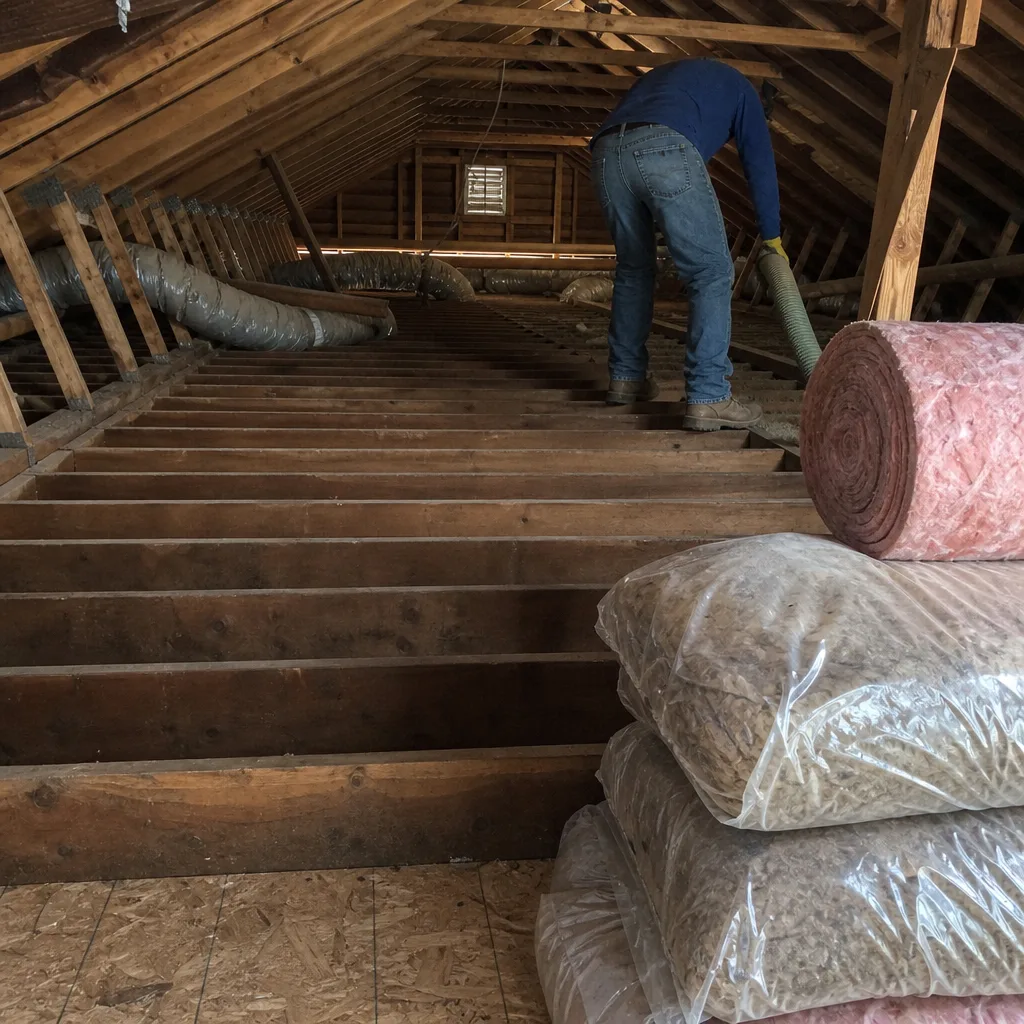
- Dealing with existing insulation that blocks rafter faces. Foil radiant barrier needs a clean rafter face to staple to and an air space in front of it to work. Loose-fill that’s drifted up against the rafters has to be raked back and re-placed after the foil is up. This is the single most common reason a “same day” quote becomes two days.
Call it one to three hours of prep on a typical Paradise attic. We build that into every timeline we quote, because leaving it out isn’t a service. If your attic also has moisture issues, the air gap and vapor control story gets more complicated, and our crawl space encapsulation and vapor barrier work in Paradise page covers how we manage that on the other side of the house.
Why Time of Day and Season Affect Crew Productivity in Paradise
Attic temperature is not a minor detail on a radiant barrier job. It’s a productivity curve. A Paradise attic can sit at 130 to 150 degrees from late morning through mid-afternoon in July and August, and crews doing radiant barrier work have to rotate in and out, hydrate, and take breaks that stretch the day. The same attic in February, in the 50s and 60s, is a comfortable workspace and lets a crew hold pace through the afternoon.
What That Means for Scheduling
- Summer installs start early. Crews come in at first light, do the bulk of the foil work before the peak heat, and finish inspection as the attic cools toward evening. A summer job that starts at 6 a.m. finishes the same day. One that starts at noon often rolls to the next morning.
- Winter installs can run the full day. Between November and March, the same crew can work straight through the afternoon. If you have flexibility on timing, January and February are genuinely faster months for radiant barrier work in Paradise.
- Rain changes the roof surface temperature. A wet roof deck cools the attic and makes access safer, but it also means the crew has to verify moisture hasn’t crept under the barrier staging, which takes a few minutes per section.
The honest scheduling advice: if you don’t have an urgent need, book radiant barrier work in the cooler months in Paradise. If you do book summer, a contractor who starts early and stages the day properly will still hit a one-day install. A contractor who shows up at 10 a.m. in August is estimating two days because the heat forces it, not because your attic is unusually hard.
Ventilation Verification: The Step That Adds Time and Saves the Job
Radiant barrier works by reflecting radiant heat before it crosses into the attic. That’s the good news. The complication is that a hot roof deck and an under-ventilated attic can combine to create moisture problems, and foil installed without checking venting is a shortcut you don’t want anyone taking in your home. Ventilation verification takes 30 to 60 minutes on a typical Paradise attic and can uncover two specific issues: intake soffit vents blocked by insulation, and exhaust vents undersized relative to the attic volume.
When we find either problem, the fix has to happen before installation, not after. Blocked soffit vents can be cleared with vent chutes and a rake in an hour. Undersized ridge or gable exhaust may need a return trip and additional hardware. This is the point in the timeline where a real estimate and a brochure estimate diverge. If a contractor quotes you four hours flat without ever asking about your vent layout, they’re either planning to skip that step or planning to find out on install day.
The Final Inspection Most Installers Skip
Here’s the accountability question to ask every contractor: how do you confirm the air gap is intact across the whole attic? The air gap is the space between the foil surface and the roof deck or rafter face. If foil is stapled tight against the deck, it doesn’t reflect. It conducts. The barrier can look perfectly installed from a photo and perform nothing like it should.
A proper final inspection walks the attic in sections with a light, confirms the foil is smooth and consistently spaced off the rafter face, checks that no sections have ballooned into contact with HVAC trunks or framing, and verifies the barrier ends at the right point at hips and valleys. On a 2,000 square foot attic that walk takes 30 to 45 minutes. It is the last thing on the timeline and the first thing to disappear when a crew is trying to beat the clock.
Every job we do is covered by the Done Right Promise: if it isn’t done right, we make it right. That’s not a slogan in the final inspection context. It means a technician comes back and fixes a gap that was missed, at no charge, for the life of the workmanship warranty. The inspection is also where we check that the crew used the specified material. Our barrier installs use products from Johns Manville, Knauf, and other manufacturers we trust, and the final walk is when a spec sheet matches what’s actually in the attic.
What to Ask Before You Accept a Timeline Estimate
A timeline estimate is only meaningful if it’s based on your attic. The questions below are the ones we’d ask if we were the homeowner, and the ones we expect from every Paradise customer who’s been burned by a vague quote before.
- “Can you describe my attic layout back to me?” If the answer doesn’t mention gable end, hip returns, ridge line, or the location of the HVAC equipment, they’re not estimating your attic. They’re estimating a number.
- “Is that a full crew or one technician?” A timeline with one installer on a 2,000 square foot hip roof is a two-day estimate dressed as a one-day job.
- “What prep is included in the estimate?” Raking back insulation, installing walk decking, and vent chute clearing should be itemized, not surprise line items.
- “How do you verify ventilation before installing?” There should be a specific answer about soffit and exhaust venting.
- “Does the estimate include the final air gap inspection?” It should, and the answer should describe it. If it doesn’t, the timeline is shorter than the work.
- “What’s the warranty on workmanship?” Materials warranties are industry standard. Workmanship warrants separate the contractors from the estimators, and a lifetime workmanship guarantee is the number to ask for.
We do a free second opinion on any written estimate in Paradise, no trip charge inside the service county, and $40 off any repair over $200. The goal is a timeline you can plan around, not a number that gets revised on install day. You can start at our Walt’s Insulation Paradise home page for the full service list.
Common Mistakes to Avoid
- Accepting a square-footage timeline without an attic inspection. Two 2,000 square foot attics in the same Paradise zip code can differ by a full day of install time. A number without an inspection is a guess.
- Scheduling radiant barrier work in the hottest week of the year without early-start planning. Paradise summers push attic temperatures into the 140s, and a crew that starts at 10 a.m. in July is working in the worst window of the day. Ask how the crew is staged for summer heat.
- Skipping the ventilation check to save time. Foil over an under-ventilated attic is a moisture problem waiting to happen. Vent verification is not a step anyone should trim from the timeline.
- Installing foil over insulation that covers the rafter faces. The air gap disappears, and so does the reflectivity. If loose-fill is piled against the rafters, it has to be moved first.
- Accepting a job without a final air gap inspection. A crew that leaves without walking the attic has no idea whether the barrier works. Photos of foil in an attic don’t confirm an air gap.
- Hiring a contractor without a published address and license number. Radiant barrier work in Paradise is a warranty-sensitive install. A local business with a real address and license will still be there in five years if the air gap fails.
- Ignoring the crawl space and attic together. Radiant barrier addresses radiant heat at the roof. It doesn’t address moisture or air leaks elsewhere. Getting both evaluated in one visit is faster than two separate appointments months apart.
When to Call a Professional
Some attic projects are safe to look at yourself. Radiant barrier installation isn’t one of them. The work involves walking on joists above ceiling height, leaning around hip returns, working around the electrical and HVAC equipment often found in Paradise attics, and managing high attic temperatures in summer. If your attic has a low pitch, cross-bracing, or multiple rooflines stitched together from additions, the safety and quality risk climbs fast. Even a straightforward gable attic is a two-person job because the foil needs one person laying and one person stabilizing.
Call a professional if your attic access is narrow, if you don’t know what’s under the existing insulation, if you’ve had moisture in the attic before, or if you want the final air gap inspection documented on the job record. Walt’s Insulation Paradise offers free estimates in Paradise, and our phones are answered by a live person 24/7. Call (844) 978-0556 to schedule an inspection.
Frequently Asked Questions
Most Paradise homes take four hours to a full day. A simple gable attic under 2,000 square feet is often four to six hours. A hip roof with low pitch, cross-bracing, or existing insulation against the rafter faces is a full day, sometimes two if ventilation corrections are needed. The attic, not the square footage, decides the timeline. Call (844) 978-0556 and we’ll give you an estimate based on your attic.
Yes, most single-family installs are one day. One-day jobs share three features: an attic the crew can walk through, ventilation that passes the check the first time, and rafter faces clear enough to staple foil without prep. If any of those isn’t true, the honest estimate is two days. Call (844) 978-0556 for a free estimate on your specific attic.
You don’t have to stay for the full install, but we do recommend being present at the start and the finish. Being there for the walkthrough at the end lets you see the air gap and ask questions while the crew is still on site. Our technicians are background-checked and uniformed, so you always know who’s in your home. Call (844) 978-0556 to schedule a day and time that works.
Existing insulation blocking the rafter faces is the single biggest time addition on Paradise installs, usually one to two extra hours. Low-pitch hip roofs, cross-bracing, and under-ventilated attics come next. Attic temperature in summer adds a half day on its own if the crew can’t start early. Call (844) 978-0556 for a free estimate that accounts for all of these before install day.
Radiant barrier installation is quiet from inside the house. Staple guns and footfall are the loudest sounds, and most of the work happens above the ceiling. There’s no sawing, no tear-out, and no debris trail through the living space beyond the access hatch. The thermostat stays on. Call (844) 978-0556 for details specific to your home.
Cooler months are faster. Between November and March, a Paradise crew can work a full day at pace in the attic, which keeps the project to one day on attics that would take two in July. If you need it done in summer, schedule an early-morning start. Call (844) 978-0556 to ask about seasonal scheduling and current availability.
The Bottom Line
Radiant barrier installation is one of the faster attic projects you can have done, but the timeline runs from four hours to two days depending on your attic, not your square footage. The variables that matter are roof geometry, prep work, ventilation, and season. If a contractor quotes you a number without ever inspecting the attic, ask the questions in this guide and compare answers. A realistic timeline, a final air gap inspection, and a workmanship warranty tied to a name and a published address are the three things that separate a good install from a one-day scramble you’ll be paying for in three years.
Walt’s Insulation Paradise is locally owned and owner-operated, with a published address and license number, and every job is covered by the Done Right Promise. Our technicians have up to 26 years of experience, and we install barrier materials from Johns Manville, Knauf, and other manufacturers we stand behind. Free second opinion on any written estimate, no trip charge inside the service county, and a permanent 10% discount for seniors and veterans. Call (844) 978-0556 for a free estimate in Paradise.
Written by the team at Walt’s Insulation Paradise.