
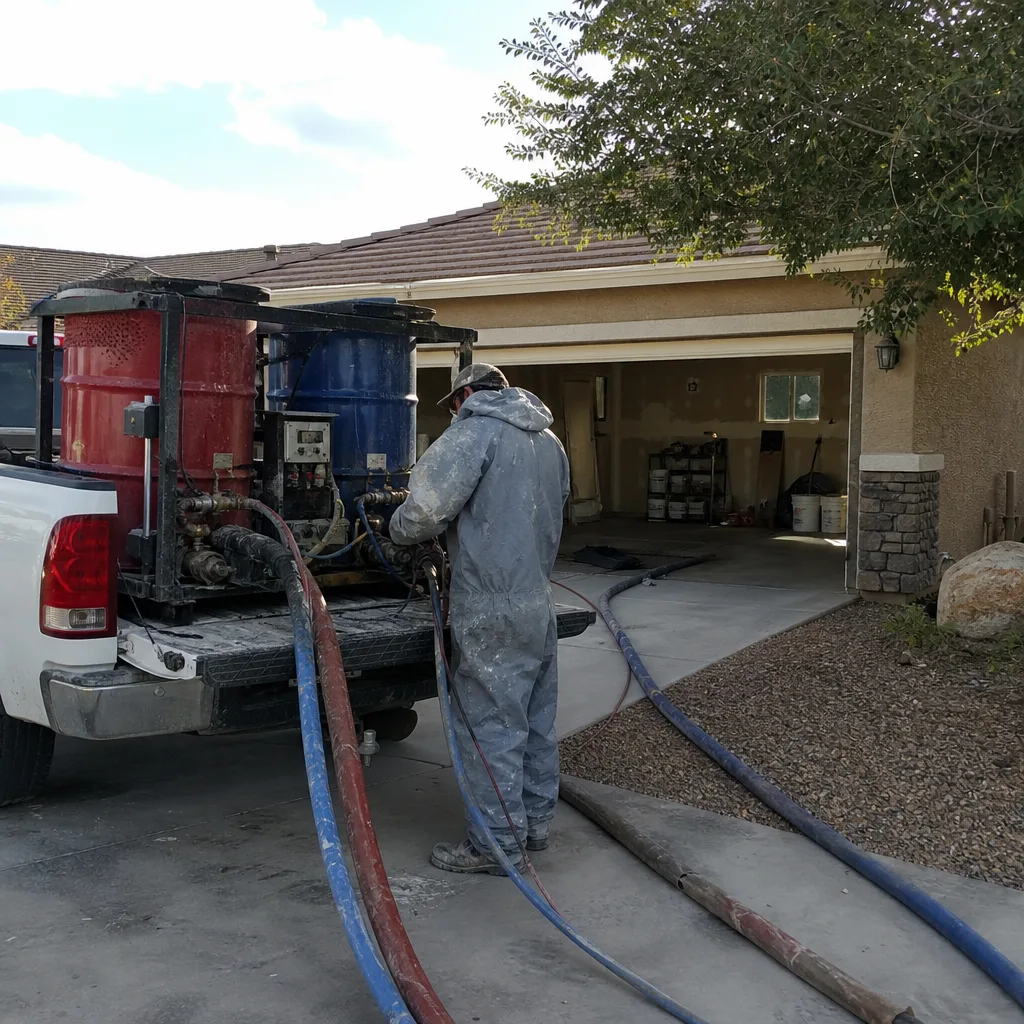
Last updated November 18, 2026
How Long Does Spray Foam Insulation Take? Timelines and What to Expect
The crew can foam a 2,000-square-foot attic in about four hours. What a lot of homeowners don’t hear until the deposit is already paid is that they’ll be sleeping somewhere else for the next 24 hours minimum, and in some applications longer. That gap between “install time” and “usable time” is the single biggest scheduling surprise in spray foam, and most companies bury it in fine print, if they mention it at all. This guide lays out the full realistic timeline by application, explains what drives the re-occupancy wait, and shows you what a straight answer from a Paradise contractor should actually look like.
Quick Answer
A typical residential spray foam job takes 2 to 6 hours of actual installation for an attic or crawl space, 1 to 3 days for wall retrofits, and rim joist work often finishes in under 4 hours. Add a re-occupancy wait of 24 hours minimum after installation, and sometimes 24 to 48 hours depending on product type, thickness, and ventilation.
Table of Contents
- Realistic Timelines by Application Type
- The Re-Occupancy Window Explained
- Why Paradise Desert Heat Changes the Clock
- Prep Work: Who Does What Before the Crew Arrives
- Why “One Day” Jobs Sometimes Turn Into Two
- Questions to Ask Before You Book
- Common Mistakes to Avoid
- When to Call a Professional
Realistic Timelines by Application Type
“How long does spray foam take” isn’t one answer, because a closed-cell crawl space job and an open-cell wall retrofit behave nothing alike. Here’s a breakdown by application, drawn from our experience across homes in Paradise and the surrounding valley.
Attic (open-cell or closed-cell)
For a 2,000-square-foot attic sprayed at the roofline, expect about 3 to 5 hours of install for open-cell, and slightly longer for closed-cell since it goes on in smaller lifts. Closed-cell requires a second pass for anything over 2 inches, which adds 1 to 2 hours. The install itself is usually one day. The 24-hour re-occupancy wait is what extends your real timeline into day two.
Crawl Space and Rim Joists
Rim joist and band joist work on a typical single-story home runs 2 to 4 hours. A full crawl space encapsulation job with spray foam on the walls plus a vapor barrier often runs one full day, sometimes two if the space is tight or heavily contaminated with debris. For a deeper look at crawl space work, see our crawl space encapsulation and vapor barrier service in Paradise.
Walls: Retrofit vs. New Construction
Retrofit wall insulation is the slow one. New construction walls can be sprayed in a few hours because the crew has open access from both sides. Retrofitting existing walls usually means drilling and injecting, or removing drywall sections if the wall cavity has obstructions. That’s typically a 1 to 3 day job in a moderate-sized Paradise home. New construction wall foam is closer to 2 to 5 hours.
Summary Table
- Attic (closed-cell, 2,000 sq ft): 4 to 6 hours install + 24 hr wait
- Attic (open-cell, 2,000 sq ft): 3 to 5 hours install + 24 hr wait
- Crawl space walls: 4 to 8 hours install + 24 hr wait
- Rim joists only: 2 to 4 hours install + 24 hr wait
- Wall retrofit: 1 to 3 days + 24 hr wait
- Wall new construction: 2 to 5 hours + 24 hr wait
The Re-Occupancy Window Explained
This is the part of the timeline most homeowners never hear clearly. Spray foam is applied as a chemical reaction, and during cure the material releases trace amounts of gas – mostly carbon dioxide and small amounts of amines or isocyanates depending on the formulation. That off-gassing is why manufacturers and contractors recommend a 24-hour re-occupancy window for most residential applications, and up to 48 hours in certain conditions.
What actually drives your specific wait:
- Product type. Water-blown open-cell foams like Icynene off-gas faster than some high-density closed-cell products from Demilec or similar lines. Ask your contractor which product they use and what the manufacturer’s re-occupancy guidance is.
- Thickness. A 5-inch closed-cell lift takes longer to fully cure than a 2-inch flash coat.
- Ventilation. Mechanical air movement during and after install shortens the window.
- Occupants. Homes with infants, elderly residents, or anyone with respiratory sensitivity often warrant the longer end of the window.
The good news: once the foam has cured, there’s no ongoing off-gassing concern. The chemistry is stable. The wait is a one-time thing, not a persistent condition.
Why Paradise Desert Heat Changes the Clock
Paradise’s summer heat is a real factor in the cure timeline, and it cuts both ways. On one hand, warm ambient temperatures and low humidity speed up initial cure. Closed-cell foam especially hits its tack-free time quickly in a 110-degree attic, which is good for the install crew turning around a second lift. On the other hand, extreme heat makes the space genuinely unsafe for anyone inside it without the crew’s own ventilation running, and it can affect the spray pattern if the substrate surface temperature climbs above the manufacturer’s recommended range.
What we’ve seen in Paradise specifically: attic jobs on a 105-degree July afternoon sometimes require early-morning starts to hit the right surface temps, which pushes the crew’s finishing time back by a couple of hours. Older Paradise homes with less air-sealed envelopes also tend to see a faster attic temperature drop after install, which shortens the practical ventilation window post-job. Crawl spaces in the valley run cooler but hold humidity longer, so cure there behaves differently from attic foam.
Prep Work: Who Does What Before the Crew Arrives
The clock starts before the crew pulls up, and the more of that pre-work is handled correctly, the shorter the whole project feels. Here’s a realistic split.
What the contractor handles
- Site inspection and moisture check (usually done during estimate)
- Setting up containment, masking, and plastic sheeting
- Removing old insulation or contaminated material if needed
- Sealing penetrations, wiring gaps, and can lights before foam
- Setting up ventilation and exhaust fans
- Applying foam and cutting excess with a trim tool
- Post-install walkthrough and cleanup
What the homeowner handles
- Clearing the work area of stored items (attic boxes, holiday decorations, crawl space clutter)
- Moving vehicles out of the driveway on install day (the crew needs space for equipment)
- Arranging somewhere for the household to be during install and the 24-hour wait
- Pets and plants: pets should be off-site for install day and ideally during the cure window
- Making sure someone is home for the walkthrough at day’s end
Attic cleaning and rodent proofing sometimes need to happen before foam, especially in Paradise homes where pack rats or roof rats have been active. That’s part of our attic insulation service in Paradise and can add half a day to a project.
Why “One Day” Jobs Sometimes Turn Into Two
A job quoted as one day does sometimes stretch to two, and that doesn’t automatically mean a bait-and-switch. Three reasons we’ve seen cause a legitimate slip:
- Hidden moisture or damage. Once insulation comes out, old water stains, mold, or failing sheathing can show up. You can’t spray foam over wet framing, so the crew has to stop, treat, and re-schedule part of the job. This is common in older Paradise construction.
- Surface temperature or weather. Desert heat or a sudden cold snap can push the substrate outside the manufacturer’s window for the foam being sprayed. Crews that care about warranty quality will pause rather than spray over the problem.
- Underestimated scope. A strong contractor’s estimate covers the surprise. A weak one lowballs to win the job and adds cost later. This is exactly why we offer a free second opinion on any written estimate – if you’ve got a proposal from another company and the scope feels thin, we’ll look at it with you.
It’s worth being clear that a one-day slip is normal and fine. A five-day surprise is not. Ask your contractor what their worst-case day-two scenario looks like before you book.
Questions to Ask Before You Book
Get these answered in writing before you put down a deposit. If a contractor can’t answer them clearly, that’s your cue to keep looking.
- “What’s the actual re-occupancy window, in hours, for the product you’ll spray?” Not “overnight.” Actual hours.
- “What happens if you find moisture or damage under the existing insulation?” There should be a defined process, not a shrug.
- “Which manufacturer’s product are you using and what’s its cure spec?” Legitimate contractors use Icynene, Demilec, Owens Corning, or a similar vetted line and know the specs.
- “Will I be able to stay in the house, or do I need to plan to be out?” You should not be in the house during install.
- “Is the installation covered by a workmanship guarantee, and for how long?” Ours is a lifetime Done Right Promise.
- “How is the space ventilated during install?” Crews that don’t bring their own ventilation aren’t doing this right.
- “Can I see your license and insurance?” They should be published, not requested.
For a starting point on what a spray foam job actually involves in Park County, see our spray foam insulation service page for Paradise.
Common Mistakes to Avoid
- Booking without asking about re-occupancy. Thinking you’ll sleep at home that night and then finding out the crew recommends 24 hours off-site creates real problems. Ask before you commit.
- Skipping the surface temperature question. Paradise summer heat can push a job back. A crew that displays flexibility in the estimate will be a crew that doesn’t rush your install to hit a schedule.
- Not clearing the attic or crawl space first. A crew that arrives to a packed attic burns 2 hours moving your stuff. That’s not their labor, that’s your timeline slipping.
- Assuming “one day” means “back to normal by dinner.” Install day ends when the foam is in. Your home is habitable again after the cure window closes, not when the truck leaves.
- Ignoring what’s under the old insulation. Old water damage, pest debris, or failing vapor barriers will surface once the original insulation is gone. Budget a bit of margin for cleanup.
- Comparing price quotes without comparing timelines. Two bids at different prices can cover very different scope. One includes prep, cleanup, and a genuine re-occupancy spec; the other may not.
- Not asking who answers the phone. If you can’t reach a live person during install day when a question pops up, the timeline headaches are worse.
When to Call a Professional
Spray foam is a professional job, full stop. The chemicals require proper ventilation, correct spray equipment, and cured-spec knowledge that a homeowner with a kit just doesn’t have. It’s not a weekend project, and the safety math on doing it yourself inside a closed attic or finished basement space is bad.
Call a professional if any of these apply:
- You’re spraying more than a couple of small rim joist sections
- You need to touch existing wiring, plumbing, or HVAC penetrations
- You’ve noticed moisture, mold, or pest activity in the space you want insulated
- You need to meet local ventilation or code requirements
- You want the work guaranteed
Walt’s Insulation Paradise offers free estimates in Paradise – call (844) 978-0556. We bring the crew, the ventilation, and the trained hands. You bring the empty attic.
Frequently Asked Questions
Most residential spray foam jobs take 2 to 6 hours of install time for an attic or crawl space, 1 to 3 days for wall retrofits, and under 4 hours for rim joist work alone. Add a 24-hour re-occupancy window on top of install time for your full timeline. Call (844) 978-0556 for a free estimate that includes the timeline specifics for your home.
No, you should plan to be out of the house during install and for at least 24 hours after. Off-gassing is short-lived but real, and infants, elderly residents, or anyone with respiratory sensitivity should be off-site for the full recommended window. Call us to confirm the exact window for the product we’ll be using in your Paradise home.
Warm temperatures do speed initial cure, but Paradise’s summer heat can also push the substrate above the manufacturer’s recommended range, which sometimes means an early-morning start. Crews that understand the local climate plan around this. Our technicians have up to 26 years of experience working in this climate specifically.
For most undersized or leaking attic and crawl space spaces in Paradise, yes. The thermal performance gains in a desert climate are significant, and the one-day disruption is easier to plan than it sounds once you know what to expect. Call us if you’d like a comparison of spray foam versus other options – estimates are free.
Open-cell foam is lighter, less expensive, and typically cures faster in the re-occupancy sense; closed-cell is denser, provides a vapor barrier on its own, and takes a bit longer to apply because it goes on in smaller lifts. Which one you want depends on the application. We can walk you through the trade-offs for your specific space.
Not over it – old insulation has to come out first. The prep step of removal often adds a few hours to your timeline but is required for the foam to bond properly and to check for problems hiding underneath. Our home page for Walt’s Insulation Paradise describes the full removal-and-replace service.
The Bottom Line
The install is fast. The wait is the story. If you’re planning a spray foam project in Paradise, budget for a day of install plus 24 hours of off-site time, and ask your contractor for the specific re-occupancy window in writing. Wall retrofits and jobs with hidden damage can stretch to two or three days, and that’s normal. What isn’t normal is a vague timeline or a contractor who won’t name the product and the cure spec. If you want a straight answer and a written scope before you commit to anything, call (844) 978-0556.
Written by the team at Walt’s Insulation Paradise.