
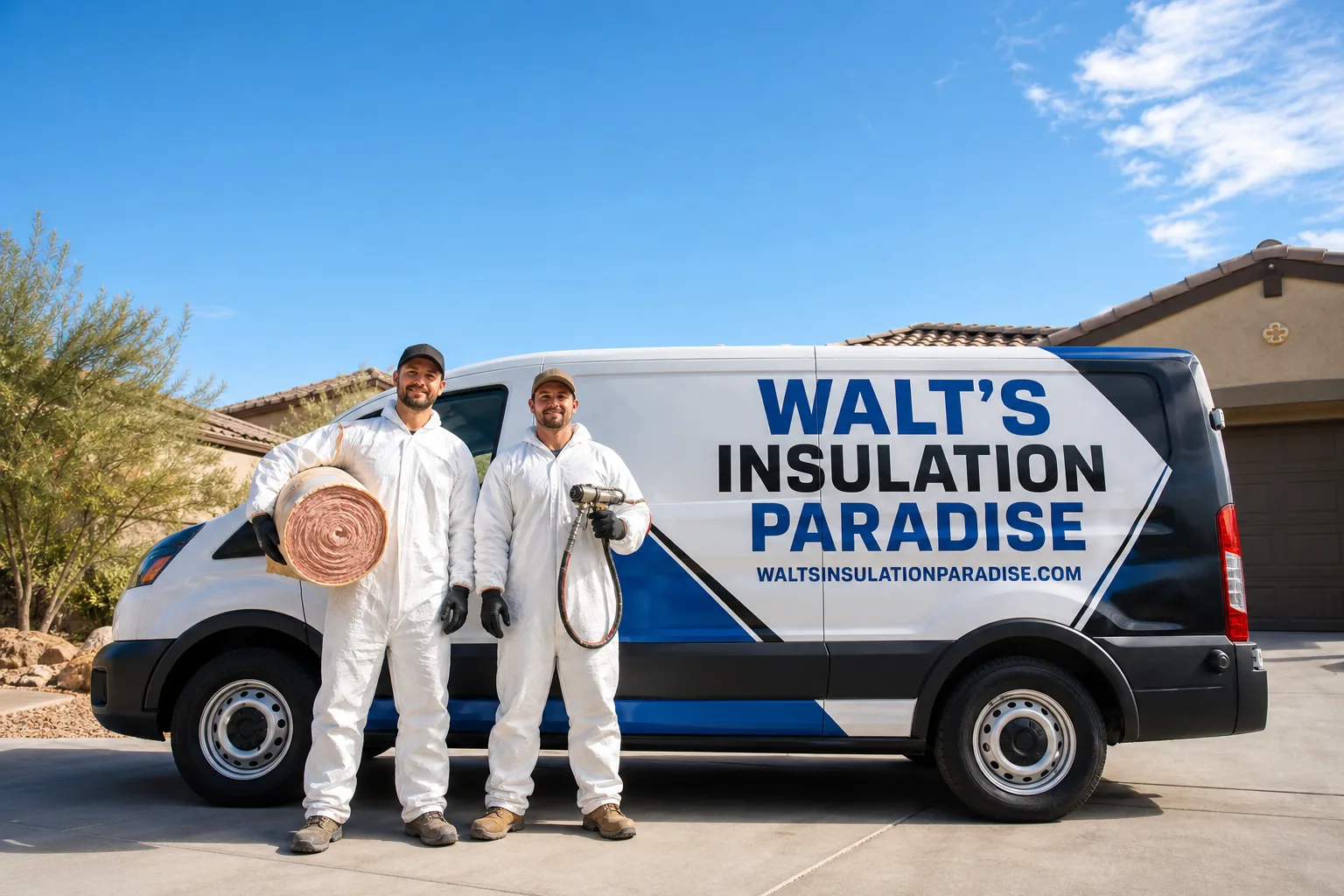
Fast, Reliable Blown-In Insulation Across Whitney
If you live in Whitney, you already know the routine: by 2 p.m. in July, the upstairs bedrooms feel like a sauna and the AC never quite catches up. Most of that heat is coming from your attic, and in the older tract homes around 89122, the insulation up there has been quietly failing for years. We install blown-in fiberglass, cellulose, and dense-pack wall insulation built for the desert, and we know this neighborhood block by block. Call (844) 978-0556 and a live person will pick up, day or night, to set up a free estimate.
Why Walt’s Insulation Paradise Is Whitney’s Preferred Blown-In Insulation Company
Whitney homeowners have been burned before. Vague quotes, crews that show up late or not at all, a phone number that dumps you into voicemail. We built this business the opposite way: locally owned and owner-operated since 2000, with a published address and license number, and phones answered by a real person around the clock. That matters when your attic is cooking and you need answers now, not next Tuesday.
Our technicians bring up to 26 years of experience to every Whitney job, and each one is background-checked and shows up in uniform so you know exactly who’s walking through your house. We back the workmanship with our lifetime Done Right Promise: if it’s not done right, we make it right, no runaround. And the standing offers are simple – $40 off any repair over $200, a free second opinion on any written estimate, no trip charge inside our service county, and a permanent 10% discount for seniors and veterans.
Response times to Whitney are quick because we’re the shop down the road, not a call center three states away. Our Blown-In Insulation team handles everything from a single-zone top-up to a full attic redo, and we treat the east-side subdivisions and the older ranch streets with the same care.
Our Blown-In Insulation Services in Whitney
Blown-In Fiberglass
Fiberglass is the workhorse for Whitney’s low-pitch roofs because it fills tight clearances evenly. We use GreenFiber and CertainTeed products and blow to a uniform depth so the coverage doesn’t dam at the soffit vents. In a slab-on-grade ranch with a shallow attic, that evenness is the difference between a settled R-11 and a real blanket of insulation.
Blown-In Cellulose
Cellulose packs denser than fiberglass and handles the occasional cold snap we get on winter nights near the freeway, when temperatures can dip close to freezing. It’s a strong choice for older Whitney homes where you want both heat resistance and a tighter seal against air movement. We measure depth as we go so you know exactly what you’re getting.
Dense-Pack Wall Insulation
A lot of Whitney’s 1970s and 1980s homes were built with walls that were never fully insulated, and the newer two-story stucco builds on the east side usually have open-cell foam in the walls but weak attics. Dense-pack fills those empty wall cavities without tearing up your drywall, which cuts the heat gain that makes west-facing rooms unbearable in August.
Blown-In Top-Up
Topping up existing insulation sounds simple, but in Whitney it usually isn’t. Under the old fiberglass surface, the material near the eaves has often settled to R-11 while the south-facing roof deck bakes at up to 170°F. A top-up that skips air-sealing, radiant barrier, and venting just pours new insulation into an oven. We fix the whole assembly first, then add insulation to a depth that actually holds.
Trusted Brands We Service in Whitney
We install products from manufacturers Whitney homeowners can look up and trust – GreenFiber, CertainTeed, Johns Manville, Owens Corning, Knauf, and Rockwool, among others. We don’t keep a warehouse of parts sitting around, so we source what each job needs and get it moving quickly, which is why most Whitney installs get scheduled without the long waits you see from the big chains. The materials are matched to your attic, your roof pitch, and how your home actually performs in the valley heat.
Common Blown-In Insulation Problems We See in Whitney Homes
- Settled fiberglass along the eaves. Original blown-in fiberglass often looks fine at the surface, but probing near the edges reveals it has compressed down to about R-11, leaving a cold strip in winter and an open heat path in summer.
- Degraded or buried radiant barrier. Foil radiant barrier from the 1980s and 1990s builds loses its reflectivity over time or gets covered by later insulation, so it stops doing its job just when you need it most.
- Low-pitch roofs with dammed insulation. Whitney’s shallow roofs leave little clearance, so blown material piles up at the vents or blocks soffit airflow, which traps heat and makes the attic hotter instead of cooler.
- Under-insulated attics over foamed walls. Newer two-story stucco homes on the east side often have open-cell foam in the walls but a thin attic, so the living space stays comfortable downstairs while the upper floor roasts.
The Whitney Attic Reality: Why a Top-Up Alone Won’t Fix It
Here’s the observation that separates a real fix from a wasted check. In Whitney’s 1970s through 2000s slab-on-grade tract homes, the original blown-in fiberglass frequently looks intact when you glance across the attic. Look closer near the eaves, though, and it’s settled to roughly R-11 and compressed over the decades. Meanwhile that south-facing roof deck can reach 170°F on a summer afternoon, and any surviving radiant barrier has usually degraded or been dusted over. Adding more insulation on top of that without addressing air-sealing, venting, and the radiant barrier just adds material to an oven. The attic assembly has to be fixed as a system before a single bag goes in.
A typical job in a Whitney ranch home goes like this: a pro probes the insulation, finds the settled eaves and exposed top plates, air-seals the ceiling plane, baffles the soffits for ventilation, repairs or installs the radiant barrier, and only then blows in fiberglass or cellulose to an even depth that respects the low roof’s tight clearances. With July highs averaging above 105°F and stretches past 110°F, attic temps climbing past 160°F, and winter nights near freezing, the insulation has to handle both extremes, not just the summer.
Pricing for Blown-In Insulation in Whitney, NV
Honest numbers for this market: a blown-in fiberglass top-up in a typical Whitney attic usually runs about $1,200 to $2,600, depending on square footage and how deep we go. Full attic re-insulation with removal of the old settled material lands around $2,000 to $4,500. Dense-pack wall insulation runs roughly $900 to $2,400 for a single-story home, and adding a radiant barrier with the venting work typically adds $700 to $1,800. Attic air-sealing before the blow-in is usually $400 to $900. What moves the price is attic size, roof pitch and clearance, whether the old insulation needs hauling out, and how much radiant barrier and venting work is required. We give you an upfront, no-hassle quote and a free second opinion on any written estimate, plus $40 off any repair over $200. Call for a free estimate.
We Also Serve Cities Near Whitney
We work all across the east valley, not just Whitney. If you’re in Whitney, Sunrise Manor, Winchester, Paradise, or Las Vegas, we can get out to you quickly and handle the same attic work with the same Done Right Promise behind it. Reach out and we’ll confirm timing for your area.
Serving Whitney, NV – Our Local Coverage Area
We serve Whitney and nearby communities. Use the map below to see the area we cover. If you’re nearby, we can almost certainly help.
FAQs – Blown-In Insulation in Whitney
No, not on its own. In a 1985 Whitney tract home, the fiberglass has usually settled to around R-11 along the eaves and the radiant barrier has often degraded, so a straight top-up just piles material into a hot attic. The right move is air-sealing, venting, and radiant barrier first, then a uniform top-up. Call us for a free estimate and we’ll tell you exactly what your attic needs.
Because insulation alone doesn’t stop heat gain if the venting and radiant barrier aren’t doing their job. In Whitney, low-pitch roofs with limited clearance let blown material dam at the vents and block soffit airflow, so the 160°F-plus attic heat has nowhere to go and pushes back into the house. A whole-attic approach fixes it; more insulation by itself won’t. Call for a second opinion, it’s free.
Fiberglass fills tight, low-clearance attics evenly and is the usual pick for Whitney’s shallow roofs, while cellulose packs denser and seals better against the winter cold snaps we get near the freeway. Both work well when installed at the right depth and with the attic assembly fixed first. We’ll recommend the right material for your specific roof and call it out in an upfront quote.
Look near the eaves, not the middle. If the material there has compressed and you can see exposed top plates on the ceiling joists, it’s likely dropped to around R-11 and overdue for attention. A quick call and we’ll come check it, and there’s no trip charge inside our service county.
Often yes, especially in the newer two-story stucco builds on the east side that have open-cell foam in the walls but a thin attic. Fixing the attic with air-sealing, venting, and a proper top-up cuts the heat load on the upper floor far more than the AC can make up for. Call (844) 978-0556 to set up a free estimate.
Ready to Stop Wasting Money on That Whitney Attic?
You’ve got a real local option: a live person on the phone 24/7, background-checked technicians in uniform, upfront pricing, and the lifetime Done Right Promise behind every job. Whether you need a top-up, dense-pack walls, or the full attic fix, we’ll tell you straight what your Whitney home needs. Call (844) 978-0556 today for a free estimate.
Written by the team at Walt’s Insulation Paradise.